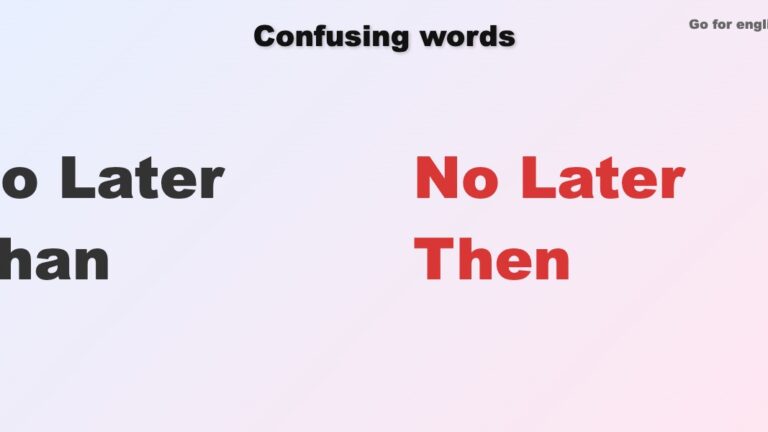
In the world of English grammar, nuances can often lead to confusion, and few phrases spark as much debate as “no later than” versus “no later then.” For learners of the language, grasping these subtle distinctions is crucial, as even a small mistake can alter the meaning of a statement entirely. Understanding the correct usage not only enhances communication skills but also boosts confidence in writing and speaking. In this article, we will unravel the complexities surrounding these two phrases, providing clear definitions and examples to help you master their application in everyday language.
Quick Summary
No Later Than is a phrase used to indicate a deadline or a specific time by which something must be completed or submitted. It emphasizes punctuality and is commonly used in both American and British English. For example, “Please submit your report no later than Friday.”
In contrast, No Later Then is a frequent misspelling of “no later than.” The word “then” refers to a point in time or a sequence of events, which is not applicable in the context of setting deadlines.
In summary, use “no later than” to express a deadline, and avoid using “no later then,” as it is incorrect.
What Do ‘No Later Than vs No Later Then’ Mean?
The phrases “no later than” and “no later then” are commonly confused due to their similar spelling. However, they serve different grammatical purposes and meanings. “No later than” is a prepositional phrase used to indicate a deadline or the latest time by which something should occur. For example, you might say, “Please submit your report no later than Friday,” meaning the report must be submitted by Friday at the latest.
On the other hand, “no later then” is a grammatically incorrect phrase. The word “then” typically refers to a point in time or a sequence of events, which does not fit in this context. Therefore, when you hear or read “no later then,” it’s likely a typo or misunderstanding. To summarize, always use “no later than” when discussing deadlines to ensure clarity and correctness in your writing.
‘No Later Than vs No Later Then’: The Differences
The distinction between “no later than” and “no later then” is crucial for effective communication and is especially significant in formal writing. As previously mentioned, “no later than” is the correct expression to convey a deadline, while “no later then” is incorrect and should be avoided. This error can lead to confusion or misunderstandings, particularly in professional settings where clarity is essential.
In American and British English, the usage of “no later than” is universally accepted, and there are no significant regional variations. However, the incorrect usage of “no later then” may pop up in casual conversation or informal writing, indicating a need for better understanding of the phrase. To illustrate, consider the following examples:
– American English: “The application must be completed no later than December 1st.”
– British English: “Please arrive at the meeting no later than 10 AM.”
In both examples, “no later than” is used correctly, emphasizing the importance of adhering to specific timelines. Understanding the correct usage helps enhance your writing and ensures that your message is communicated effectively.
Regional Preferences: No Later Than vs No Later Then
English is a diverse language that varies significantly across different regions, reflecting unique cultures and communication styles. One area of variation is the usage of phrases like No Later Than vs No Later Then, which may appear straightforward but actually carry different connotations in various English-speaking regions. Choosing the correct form often depends on the audience and context, making it essential to understand these regional differences.
American English
In American English, the phrase No Later Than is predominantly used in formal and informal contexts. For example: “Please submit your report by No Later Than Friday at 5 PM.” In the United States, this version is more commonly used because it clearly conveys a deadline that must be met, aligning with the straightforward communication style favored in American culture.
British English
Conversely, British English tends to favor the phrase No Later Then in certain informal contexts, although No Later Than is also widely accepted. An example would be: “The train will arrive No Later Then 10 AM.” In British English, this form is preferred in casual conversation as it reflects a more relaxed approach to time-related expressions, even though it can lead to confusion in formal writing.
Examples in Context: No Later Than vs No Later Then
Understanding the correct usage of “no later than” and “no later then” is crucial for effective communication. Real-life examples clarify how each term functions in different contexts, providing practical insights that enhance comprehension. These examples will help learners confidently distinguish between the two terms in their writing and conversations.
No Later Than
- The project deadline is set for Friday, no later than 5 PM.
- Please submit your application no later than the end of this month.
- The train departs no later than 10 AM, so be sure to arrive early.
- We need to receive your confirmation no later than tomorrow.
- He promised to return the book no later than next week.
- The event will start no later than 6 PM, so don’t be late.
- All reports must be filed no later than the last day of the quarter.
- Students should arrive at the exam hall no later than 30 minutes before the start.
No Later Then
- We had a great time at the party, and he was the life of the event, no later then anyone else.
- Her enthusiasm was evident, no later then her dedication to the project.
- The weather was chilly, no later then what we expected for winter.
- He was surprised by the outcome, no later then we all were.
- Her skills improved, no later then her commitment to practice.
- The instructions were unclear, no later then what we had discussed.
- He was confident in his abilities, no later then his past experiences showed.
- She felt overwhelmed, no later then her busy schedule suggested.
Synonyms & Antonyms of No Later Than vs No Later Then
Learning synonyms and antonyms is an essential part of improving your vocabulary. By incorporating synonyms into your speech and writing, you can add variety and avoid repetition, making your communication more engaging. On the other hand, understanding antonyms helps clarify the precise meaning of a word, allowing you to express your thoughts more accurately. Knowing different word choices can significantly enhance your fluency and make you sound more natural in English.
| Phrase | Synonyms | Antonyms |
|---|---|---|
| No Later Than | By, Before, Prior to | Later than, After, Following |
| No Later Then | Not applicable | Not applicable |
Common Mistakes and How to Avoid Them
Understanding common mistakes is essential for mastering the correct usage of “No Later Than” and “No Later Then.” Even advanced learners can stumble upon these phrases, and correcting these errors is key to enhancing fluency and accuracy in English. Below are the most frequent mistakes and how to avoid them.
- Using “No Later Then” instead of “No Later Than”: Remember that “than” is a conjunction used for comparisons, while “than” is the correct choice for indicating a deadline. To avoid this mistake, always think of “than” as relating to time constraints.
- Confusing “No Later Than” with “By”: While both phrases indicate a deadline, “No Later Than” emphasizes the final time allowed. Use “No Later Than” for formal contexts where precision is crucial. To avoid confusion, reserve “by” for more casual or flexible situations.
- Omitting context: Some learners forget to provide context when using these phrases, leading to ambiguity. Always ensure that the time frame is clear. For instance, instead of saying “Submit your report no later than,” specify the date, e.g., “Submit your report no later than March 15.”
- Regional differences: In some regions, the phrase “by” may be more commonly used than “No Later Than.” Be aware of your audience and adjust your language accordingly. If in doubt, use the more formal “No Later Than” for clarity.
- Overusing the phrase: Some learners tend to use “No Later Than” excessively in informal communication. To maintain a natural tone, use it primarily in formal writing or business communications.
Tips for Correct Usage
Mastering the correct usage of “No Later Than” and “No Later Then” is essential for clear and effective communication. Using these phrases accurately not only enhances your writing’s professionalism but also ensures grammatical precision. Below are practical tips to help you navigate the differences between these commonly confused phrases.
- Understand the Definitions: “No Later Than” indicates a specific deadline, while “No Later Then” is a common mistake. Always use “No Later Than” in formal writing.
- Check for Context: Ensure the phrase fits the context of your sentence. If you are referring to a time limit, “No Later Than” is the correct choice.
- Use Formal Language: In professional or academic writing, prioritize “No Later Than” to convey a sense of urgency and clarity.
- Avoid Common Pitfalls: Be aware that “No Later Then” is incorrect and should be avoided in all forms of writing.
- Utilize Style Guides: Refer to reputable style guides (like APA or MLA) for further clarification on the usage of deadlines in writing.
- Practice Makes Perfect: Regularly review and practice using “No Later Than” in various sentences to reinforce your understanding of its correct usage.
- Seek Feedback: When in doubt, ask a peer or mentor to review your writing for correct usage of phrases related to deadlines.
Frequently Asked Questions
What is the difference between “no later than” and “no later then”?
“No later than” is the correct phrase used to indicate a deadline, while “no later then” is a common misspelling of the former.
How do you use “no later than” in a sentence?
You can use “no later than” to set a specific deadline, for example, “Please submit your application no later than Friday.”
Is “no later then” correct in any context?
No, “no later then” is incorrect and should always be replaced with “no later than” to convey the intended meaning properly.
Can “no later than” be used in formal writing?
Yes, “no later than” is appropriate for both formal and informal writing when indicating a deadline.
What are some synonyms for “no later than”?
Synonyms include “by,” “before,” and “up to,” depending on the context of the sentence.
Are there any grammatical rules for using “no later than”?
There are no specific grammatical rules, but ensure it is followed by a time frame, such as a date or a specific time.
Why do people confuse “than” and “then”?
The confusion often arises from their similar pronunciations and the fact that “then” is commonly used in time-related phrases, while “than” is used for comparisons.
Can “no later than” be used in everyday conversation?
Yes, it can be used in everyday conversation to set expectations for deadlines or time limits clearly.