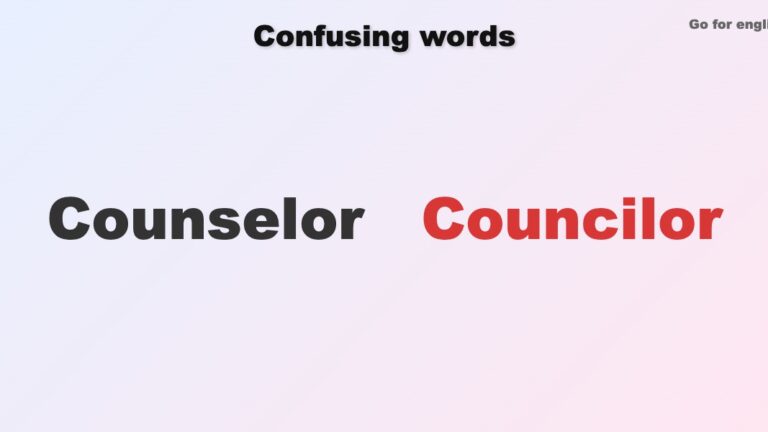
In a world where spelling nuances can lead to misunderstandings, the distinction between “counselor” and “councilor” often puzzles English learners. This confusion is not just a matter of semantics; grasping the difference between these two terms can enhance your communication skills and comprehension, especially in professional and academic settings. By clarifying their unique meanings and contexts, you’ll be better equipped to navigate conversations and written texts where these words appear. Let’s delve into the definitions and usages of “counselor” and “councilor” to illuminate their roles and help you use them correctly.
Quick Summary
The terms counselor and councilor are often confused due to their similar spelling and pronunciation but have distinct meanings and usages. A counselor refers to a professional who provides guidance and support, often in a therapeutic or educational setting, such as a school counselor or a mental health counselor. In contrast, a councilor is a member of a council, typically involved in local government or community decision-making. Regionally, counselor is the preferred spelling in American English, while councilor is commonly used in both American and British English. Understanding these differences can enhance clarity in communication.
What Do ‘Counselor vs Councilor’ Mean?
The terms ‘counselor’ and ‘councilor’ are often confused due to their similar spelling and pronunciation, but they have distinct meanings and uses. A ‘counselor’ is a professional who provides guidance, advice, or support, often in educational, therapeutic, or legal settings. For example, a school counselor helps students navigate academic and personal challenges. In contrast, a ‘councilor’ refers to a member of a council, which is an assembly of individuals convened to make decisions or provide oversight within a particular community or organization. For instance, a city councilor participates in local government discussions about policies and community issues. Understanding these definitions helps clarify their grammatical roles: ‘counselor’ functions as a noun denoting a person offering advice, while ‘councilor’ describes an elected or appointed member of a governing body.
‘Counselor vs Councilor’: The Differences
While ‘counselor’ and ‘councilor’ serve different purposes in language, their usage can vary based on regional preferences and contexts. In American English, ‘counselor’ is widely used to refer to professionals in educational and therapeutic roles, while ‘councilor’ is used for individuals in political positions, such as city councilors. In British English, however, ‘councilor’ remains the standard spelling for members of local government councils, and ‘counselor’ is less commonly used outside of specific contexts like mental health. For example, one might say, “The school counselor organized a workshop,” versus “The councilor proposed a new community project.” These distinctions highlight not only the different meanings but also the stylistic choices that can arise depending on geographical location, making it essential to use the correct term according to the context. Understanding ‘counselor vs councilor’ ensures clear communication and proper usage in both written and spoken English.
Regional Preferences: Counselor vs Councilor
English is a dynamic language that varies significantly across different regions, reflecting diverse cultural and linguistic influences. One such example is the distinction between “Counselor” and “Councilor,” which may appear straightforward but carries regional nuances in usage. Choosing the correct form often depends on the audience and context, making it essential to understand these variations.
Explanation of Regional Differences
American English
In American English, the term Counselor is predominantly used in contexts related to guidance, support, or advice, such as in educational or therapeutic settings. For example: “She decided to see a school Counselor for career advice.”
This usage is preferred in the United States because it aligns with the common understanding of a professional who provides counsel or guidance, particularly in schools and mental health services.
British English
Conversely, in British English, the term Councilor is more frequently employed when referring to a member of a local government council. For example: “The local Councilor organized a community meeting to discuss development plans.”
This form is preferred in Britain, as it directly relates to the political context of local governance, adhering to the traditional spelling conventions found in the UK.
Examples in Context: Counselor vs Councilor
Understanding the correct usage of “counselor” and “councilor” is essential for effective communication. Real-life examples provide practical insights into how each term is used in different contexts. By examining these examples, learners will gain confidence in distinguishing between “counselor” and “councilor” in their writing and conversations.
Counselor
- The school counselor helped students choose their courses for the upcoming year.
- After the traumatic event, she decided to see a counselor for support.
- As a career counselor, he provides guidance to job seekers.
- The counselor recommended various strategies for coping with stress.
- She works as a guidance counselor at a local high school.
- The mental health counselor specializes in adolescent issues.
- During the workshop, the counselor shared valuable resources for parents.
- He chose to become a substance abuse counselor to help others.
Councilor
- The councilor proposed a new initiative to improve public transportation.
- As a city councilor, she represents the interests of her constituents.
- The local councilor held a community meeting to discuss neighborhood safety.
- He was elected as a councilor after running a successful campaign.
- The councilor advocated for environmental protection policies.
- In her role as a councilor, she works closely with city planners.
- The councilor’s efforts led to the renovation of the community park.
- Many residents attended the councilor’s town hall to voice their opinions.
Synonyms & Antonyms of Counselor vs Councilor
Learning synonyms and antonyms is essential for enhancing your vocabulary and language skills. Synonyms allow for variety in speech and writing, helping to avoid repetition and making communication more engaging. On the other hand, antonyms clarify the meaning of words by providing contrasting options, which can be particularly useful in understanding the context. By expanding your knowledge of different word choices, you can sound more fluent and natural in English, enabling you to express yourself more effectively.
| Word | Synonyms | Antonyms |
|---|---|---|
| Counselor | Advisor, Guide, Consultant, Advocate, Mentor | Client, Patient, Student, Adversary |
| Councilor | Member, Legislator, Representative, Delegate | Constituent, Voter, Citizen, Non-member |
Common Mistakes and How to Avoid Them
Understanding the differences between “counselor” and “councilor” is essential for mastering English, as even advanced learners can occasionally confuse these terms. Recognizing and correcting these common mistakes not only enhances fluency but also ensures accuracy in communication.
- Using “counselor” when referring to a member of a council: The correct term is “councilor.” To avoid this mistake, remember that a councilor is someone who serves on a local government council.
- Mixing up the definitions: A “counselor” provides guidance or advice, often in a therapeutic or educational setting. To differentiate, associate “counselor” with counseling services, while “councilor” pertains to governance.
- Spelling errors: Ensure you spell “counselor” with a “u” in American English and “counsellor” in British English. Familiarize yourself with these regional variations to avoid confusion.
- Contextual misuse: Using “councilor” in contexts related to mental health or education can lead to misunderstandings. To prevent this, always consider the context in which you are using these words.
- Assuming both terms are interchangeable: They have distinct meanings and uses. To avoid this error, practice using them in sentences, ensuring you understand their specific roles.
Tips for Correct Usage
Mastering the correct usage of “Counselor” vs “Councilor” is essential for effective communication in writing. Using these terms accurately not only enhances clarity and professionalism but also demonstrates grammatical precision. Below are practical tips to help you navigate these commonly confused words.
- Understand Definitions: Remember that a “Counselor” refers to a person who gives advice or guidance, while a “Councilor” is a member of a council.
- Check Context: Always consider the context of your writing. Use “Counselor” when discussing roles in education, mental health, or legal settings; use “Councilor” for political or community-related discussions.
- Avoid Assumptions: Don’t assume that “Counselor” is always the correct term when advising someone. Verify the role being described.
- Be Mindful of Spelling: The spelling of these terms is crucial. Ensure you do not mix them up in your writing to maintain clarity.
- Use Regional Variations: In some regions, the preferred term may differ. Familiarize yourself with local usage to enhance relevance in your writing.
- Proofread Your Work: Always proofread to catch any misuse of “Counselor” and “Councilor.” This helps ensure grammatical accuracy.
- Consult Reliable Sources: When in doubt, refer to dictionaries or style guides for clarification on these terms.
Frequently Asked Questions
What is the difference between a counselor and a councilor?
A counselor is a professional who provides guidance and support, often in mental health or educational settings. A councilor, on the other hand, is an elected official who serves on a local council and makes decisions regarding community matters.
How do you spell counselor?
The correct spelling is “counselor,” with one “l.” This term is commonly used in the context of mental health, education, and legal advice.
Can you be both a counselor and a councilor?
Yes, an individual can hold both titles if they are qualified as a mental health professional and are also elected to a council. However, the roles and responsibilities are distinct.
Is it correct to say councilor or counselor for a mental health professional?
It is incorrect to use “councilor” when referring to a mental health professional; the proper term is “counselor.”
Which term is more commonly used in the U.S.?
What qualifications does a counselor need?
A counselor typically needs a relevant degree in psychology or social work, along with state licensure or certification, depending on the specific field.
Are there different types of counselors?
Yes, there are various types of counselors, including school counselors, mental health counselors, and career counselors, each specializing in different areas of support.
How do I choose between a counselor and a councilor for my needs?
If you need mental health support or guidance, seek a counselor. If you need assistance with community issues, policies, or local governance, a councilor would be appropriate.