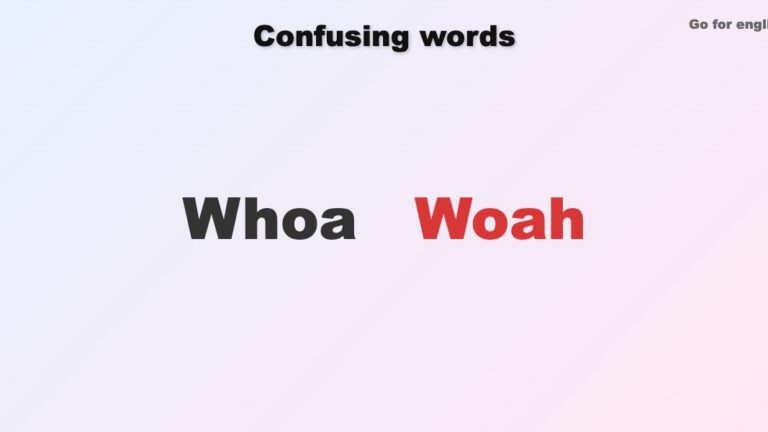
The English language is filled with quirky spellings and pronunciations that often leave learners scratching their heads. One such pair that frequently causes confusion is “whoa” and “woah.” Understanding the distinction between these two expressions is essential not only for clear communication but also for grasping the nuances of informal writing and speech. In this article, we’ll explore the origins, meanings, and proper usage of both terms, helping you navigate this common pitfall with confidence.
Whoa and Woah are two variations of an interjection used to express surprise, amazement, or to urge someone to stop. The more commonly accepted spelling is Whoa, particularly in American English, while Woah has gained popularity in informal contexts, especially on social media. Both forms are generally interchangeable, but Whoa is preferred in formal writing and may be considered more standard. In contrast, Woah is often used in a more casual setting. Regardless of the spelling, both convey a similar meaning and emotional response, but it’s essential to be mindful of the context and audience when choosing which version to use.
What Do ‘Whoa vs Woah’ Mean?
The terms ‘Whoa’ and ‘Woah’ are interjections used to express surprise, excitement, or to command someone to stop or slow down. Both variations are phonetic spellings of the same sound, primarily used in informal contexts. While they serve the same grammatical role, the choice between ‘Whoa’ and ‘Woah’ often comes down to personal preference or stylistic choice. For instance, you might say, “Whoa! That roller coaster was intense!” or “Woah, I didn’t see that coming!” In both examples, the word emphasizes the speaker’s reaction to a surprising or thrilling situation.
‘Whoa vs Woah’: The Differences
When it comes to ‘Whoa vs Woah’, the differences are subtle yet noteworthy. ‘Whoa’ is the more traditional spelling and is widely accepted in American English, often appearing in literature and media. On the other hand, ‘Woah’ has gained popularity in recent years, particularly in digital communication and social media platforms. Some users might prefer ‘Woah’ for its modern aesthetic or to convey a more casual tone. For example, a British English speaker might lean towards ‘Whoa’ in writing, while a younger audience on social media might opt for ‘Woah’ to capture a laid-back vibe. Regardless of the spelling, the essence of the expression remains the same, showcasing the ever-evolving nature of language and regional preferences.
Regional Preferences: Whoa vs Woah
English is a rich and diverse language that varies significantly across different regions. While the terms Whoa and Woah may appear to be universally understood, their usage can differ depending on geographic location. Choosing the correct form often hinges on the audience and context, making it essential to understand these regional preferences.
American English: In the United States, the term Whoa is more commonly used in informal settings. For example, “I couldn’t believe my eyes when I saw that Whoa car zoom past!” This version is preferred in American English because it aligns with phonetic spelling and is widely recognized in popular culture.
British English: In contrast, British English tends to favor the spelling Woah. An example sentence would be, “When she finished the race, everyone shouted Woah in amazement!” This form is often preferred in British English as it reflects a more traditional approach to phonetic representation, making it feel more authentic to British speakers.
Examples in Context: Whoa vs Woah
Understanding the correct usage of “Whoa” and “Woah” is crucial for effective communication. Real-life examples can provide practical insights into how each term is used in different contexts. By examining these examples, learners can confidently distinguish between “Whoa” and “Woah” in their writing and conversations.
Examples of “Whoa”
- “Whoa! That roller coaster was faster than I expected!”
- “When she revealed her surprise party plans, I couldn’t help but say, ‘Whoa!'”
- “Whoa, take a moment to think about your answer before you respond.”
- “He said ‘Whoa’ when he saw the stunning view from the mountain top.”
- “‘Whoa!’ she exclaimed, as she stumbled upon the unexpected gift.”
- “When the fireworks lit up the sky, everyone around me shouted ‘Whoa!'”
- “He had a ‘Whoa’ moment when he realized he had won the lottery.”
- “‘Whoa, that’s a big dog!’ she remarked as she saw the Great Dane.”
Examples of “Woah”
- “Woah, that was an impressive performance by the dancers!”
- “I said ‘woah’ when I heard the news about my friend’s promotion.”
- “After hearing the explanation, I thought, ‘Woah, I never knew that!'”
- “Woah! This cake is almost too beautiful to eat!”
- “He paused, looking at the complex puzzle and said, ‘Woah, this is challenging!'”
- “‘Woah, I can’t believe how much you’ve improved in just a few weeks!'”
- “She exclaimed ‘Woah!’ when the magician performed a stunning trick.”
- “As the car drifted around the corner, I muttered, ‘Woah, that was close!'”
Synonyms & Antonyms of Whoa vs Woah
Expanding your vocabulary is essential for effective communication in English. Learning synonyms allows you to add variety to your speech and writing, making your language more engaging and expressive. On the other hand, understanding antonyms clarifies the meaning of words by showcasing their opposites, enhancing your overall comprehension. By familiarizing yourself with different word choices, you can sound more fluent and natural in English. Below is a table listing the synonyms and antonyms for “Whoa” and “Woah.”
| Word | Synonyms | Antonyms |
|---|---|---|
| Whoa | Stop, Hold on, Wait | Go, Continue, Proceed |
| Woah | Whoa, Hold on, Wait a minute | Go, Move forward, Advance |
Common Mistakes and How to Avoid Them
Understanding common mistakes is essential for mastering the differences between “Whoa” and “Woah.” Even advanced learners can occasionally confuse these terms, leading to inaccuracies in communication. By learning to correct these errors, you can enhance your fluency and ensure your writing is polished and precise.
- Using “Woah” in Formal Writing: Many learners mistakenly use “Woah” instead of “Whoa” in formal contexts.
Correction: Reserve “Whoa” for all written contexts, as it is the accepted spelling in standard English. - Misunderstanding Context: Some people use “Woah” to express surprise or excitement but may not realize it’s less recognized.
Correction: Use “Whoa” to convey surprise in both spoken and written language, while “Woah” is often considered informal and less standard. - Regional Variations: In some regions, “Woah” may be more commonly accepted, leading to confusion.
Correction: Familiarize yourself with regional preferences, but lean towards “Whoa” for universal understanding. - Incorrect Use in Dialogue: Writers sometimes use “Woah” in dialogue, thinking it sounds more casual.
Correction: Stick with “Whoa” in all dialogue to maintain consistency and correctness. - Overusing Either Term: Learners may excessively use either term, making their writing feel repetitive.
Correction: Use synonyms or vary your expressions to avoid redundancy while still conveying surprise or excitement.
Tips for Correct Usage
Mastering the correct usage of “Whoa” vs “Woah” is essential for clear and professional writing. Using these terms accurately not only enhances your communication but also demonstrates grammatical precision. Below are some practical tips to help you navigate the differences between these two expressions effectively.
- Understand the Standard: “Whoa” is the widely accepted spelling in standard English, while “Woah” is often considered a non-standard variant.
- Use Context Wisely: Reserve “Whoa” for formal writing and “Woah” for casual or creative contexts, such as social media or artistic expressions.
- Check Regional Preferences: Be aware that some regions may favor one spelling over the other, so consider your audience when choosing which to use.
- Avoid Overuse: Limit the use of both terms to maintain professional tone. Overusing exclamations can detract from your message.
- Stay Consistent: Choose one spelling and stick with it throughout your writing to avoid confusion.
- Review Style Guides: Consult relevant style guides (like APA or Chicago) for specific recommendations on usage, especially in academic writing.
- Practice Makes Perfect: Familiarize yourself with examples of both terms in literature or popular media to better understand their contexts.
Frequently Asked Questions
What is the difference between Whoa and Woah?
Whoa is the standard spelling used to express surprise or to command someone to stop, while woah is an informal variant that some people use, but it’s not widely recognized in formal writing.
When should I use Whoa?
You should use whoa in writing or speech when you want to convey astonishment or to tell someone to halt, especially in formal contexts.
Is Woah a correct spelling?
While woah is often used in casual conversations, it is considered a nonstandard spelling of whoa and should be avoided in formal writing.
Can Whoa be used in formal writing?
Yes, whoa can be used in formal writing, particularly in dialogue or narratives where expressing surprise is appropriate.
Are Whoa and Woah interchangeable?
No, whoa is the accepted spelling in standard English, while woah is considered slang and may not be understood by all readers.
What is the origin of the word Whoa?
Whoa originates from the Old English word “hwa,” which means “to stop” and has evolved into its current usage in modern English.
How do you pronounce Whoa?
Whoa is pronounced as “woh,” rhyming with “go,” and is used to express surprise or to command attention.
Is there a grammatical rule for using Whoa?
There are no strict grammatical rules for using whoa, but it is typically used as an interjection at the beginning or end of a sentence to convey emotion.