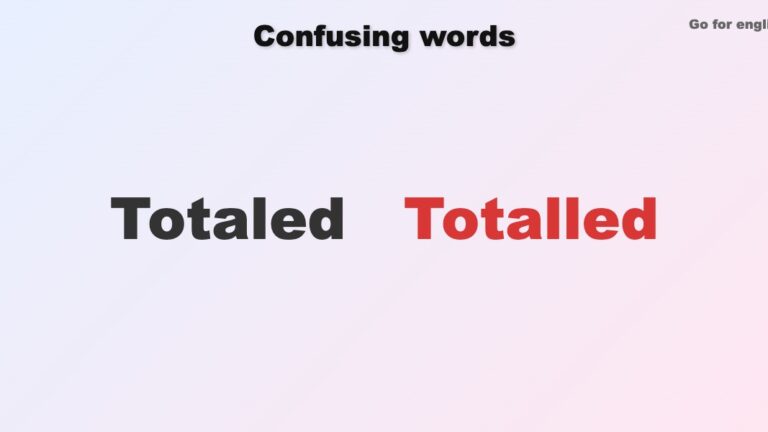
Confusing similar words can be a common pitfall for English learners, and the distinction between “totaled” and “totalled” is a prime example. This pair of words, while sounding identical, carries nuances that can impact the clarity of your writing. Understanding the difference is crucial not only for effective communication but also for enhancing your writing skills. In this article, we’ll explore the meanings, usage, and regional preferences of “totaled” and “totalled,” helping you navigate this common conundrum with confidence.
Totaled and totalled are two spellings of the same word, which means to completely destroy or render something unusable, often used in the context of vehicles that have been significantly damaged in an accident. The key difference between the two lies in regional preferences: “totaled” is the preferred spelling in American English, while “totalled” is used in British English. Both forms convey the same meaning, but it is important to use the appropriate version depending on the audience’s location. In summary, choose “totaled” for American contexts and “totalled” for British contexts to ensure proper usage.
What Do ‘Totaled vs Totalled’ Mean?
The terms ‘totaled’ and ‘totalled’ refer to the same concept: the complete destruction or loss of something, often used in the context of vehicles that have been damaged beyond repair. Both words serve as the past tense of the verb ‘total,’ meaning to calculate the overall amount or to sum up. The key difference lies in their spelling, which is influenced by regional variations in English. In American English, ‘totaled’ is the preferred spelling, while British English favors ‘totalled.’ For example, you might say, “After the accident, the car was deemed totaled,” if you’re using American English. Alternatively, in British English, you might say, “The insurance company reported that the car was totally destroyed, or totalled.”
‘Totaled vs Totalled’: The Differences
While ‘totaled’ and ‘totalled’ essentially convey the same meaning, their usage can vary based on regional preferences and stylistic choices. In American English, the single ‘l’ in ‘totaled’ is standard, reflecting a trend of simplifying spellings. Conversely, British English retains the double ‘l’ in ‘totalled,’ aligning with other similar verbs like ‘cancelled’ and ‘travelled.’ This distinction is not merely aesthetic; it can reflect the writer’s audience. For example, in a document aimed at American readers, one would use ‘totaled’ to ensure clarity and consistency. In contrast, a British audience would expect ‘totalled.’ Understanding these differences is crucial for effective communication, especially in writing that targets specific regions.
Regional Preferences Totaled vs Totalled
English is a diverse language with variations that can depend on geography, culture, and even individual preference. While the terms Totaled and Totalled may appear straightforward, their usage often diverges significantly between regions. Choosing the correct form is essential for effective communication, as it can affect how your message is received based on your audience and context.
American English
In the United States, the preferred spelling is Totaled. For example: “The company totaled their assets at the end of the fiscal year.” Below this sentence, it’s worth noting that American English tends to favor the simpler -ed endings for past tense verbs, making Totaled the standard choice in this context.
British English
Conversely, in British English, the form Totalled is commonly used. For instance: “The charity totalled over a million pounds in donations last year.” This preference is rooted in the British tendency to double consonants when adding -ed endings to verbs, especially when the stress falls on the final syllable, hence leading to the use of Totalled.
Examples in Context: Totaled vs Totalled
Understanding the correct usage of “totaled” and “totalled” is crucial for effective communication in English. Real-life examples provide practical insights into how each term is used in different contexts, helping learners to confidently distinguish between the two in their writing and conversations.
Totaled
Here are some examples showcasing the correct usage of “totaled”:
- After the accident, the car was completely totaled, leaving the owner with no choice but to buy a new one.
- The accountant totaled the expenses for the month and reported them to the manager.
- Sadly, the storm totaled several homes in the neighborhood, displacing many families.
- Once the sales figures were totaled, it was clear that the company had exceeded its targets.
- During the meeting, she totaled the votes and announced the winning proposal.
- The insurance company deemed the vehicle totaled, and the owner received a fair settlement.
- He carefully totaled the points accumulated over the season to determine the final rankings.
- After reviewing the data, she realized the project had totaled more than the initial budget.
Totalled
Below are examples that illustrate the correct usage of “totalled”:
- The test results were totalled at the end of the week to assess the students’ performance.
- In British English, ‘totalled’ is preferred when referring to a car that has been significantly damaged.
- The charity event’s contributions were totalled, revealing a surprising amount raised for the cause.
- After the game, the referee totalled the fouls committed by each player.
- She totaled her savings over the years and found she could finally afford the trip she always wanted.
- The researcher totalled the number of participants in the study to ensure accuracy in reporting.
- In the report, the data from the previous year was totalled to provide a clear comparison.
- His final grade was totalled after including all assignments and exams from the semester.
Synonyms & Antonyms of Totaled vs Totalled
Expanding your vocabulary is essential for effective communication in English. Learning synonyms allows you to add variety to your speech and writing, making your expression more dynamic and engaging. On the other hand, understanding antonyms helps clarify the meaning of words, allowing for more precise communication. By mastering different word choices, you can enhance your fluency and sound more natural in conversations.
| Word | Synonyms | Antonyms |
|---|---|---|
| Totaled | Calculated, Summed, Added up | Subtracted, Divided, Reduced |
| Totalled | Counted, Tallied, Aggregated | Minimized, Decreased, Diminished |
Common Mistakes and How to Avoid Them
Understanding common mistakes is essential for mastering the differences between “totaled” and “totalled.” Even advanced learners can trip up on these variations, which can affect both fluency and accuracy in English. By learning to identify and correct these errors, you can enhance your writing skills significantly.
- Using “totaled” in British English: Many learners mistakenly use “totaled” when writing in British English. Remember to use “totalled” instead. Correction: Use “totalled” for British contexts.
- Confusing “totaled” with other forms: Some may confuse “totaled” with similar words like “toted” or “told.” Correction: Focus on the context; “totaled” relates to something being completely destroyed or written off.
- Omitting the double “L”: In informal writing, it’s common to drop the second “L” in “totalled.” Correction: Always include the double “L” in British English to ensure proper spelling.
- Regional usage confusion: Some learners may not be aware that “totaled” is primarily used in American English, while “totalled” is preferred in British and Commonwealth English. Correction: Know your audience and adjust your spelling accordingly.
- Assuming both forms are interchangeable: It’s a common misconception that “totaled” and “totalled” can be used interchangeably. Correction: Always use “totaled” for American English and “totalled” for British English to avoid mistakes.
Tips for Correct Usage
Mastering the correct usage of “totaled” vs. “totalled” is essential for clear and professional writing. This distinction not only enhances your grammatical accuracy but also reflects your attention to detail. Understanding these differences will improve the clarity of your communication and help you avoid common mistakes. Here are some practical tips to guide you in using these terms correctly.
- Know the Variants: Remember that “totaled” is the American English spelling, while “totalled” is used in British English. Choose based on your audience.
- Consistency is Key: Once you select a spelling variant, stick with it throughout your document to maintain professionalism.
- Context Matters: Use “totaled” or “totalled” only in contexts where the term refers to summing up amounts or describing something that has been completely destroyed.
- Be Aware of Regional Preferences: If writing for an international audience, consider using “totaled” for American readers and “totalled” for British readers to ensure clarity.
- Avoid Unnecessary Variations: Do not mix the two spellings in the same document, as this can confuse readers and detract from your credibility.
- Proofread for Accuracy: Always double-check your work to ensure the correct spelling is used consistently and appropriately.
Frequently Asked Questions
What is the difference between totaled and totalled?
Totaled is the American English spelling, while totalled is the British English spelling of the same word, meaning something that has been completely damaged or declared a total loss.
When should I use totaled?
You should use totaled when writing in American English, especially in contexts related to insurance or vehicle damage.
When should I use totalled?
Totalled is used in British English and should be used in contexts where British spelling conventions are preferred.
Is ‘totaled’ or ‘totalled’ more commonly used?
Totaled is more commonly used in the United States, while totalled is the standard spelling in the UK and other English-speaking countries.
Can I use totaled in British English?
While some may understand it, it is best to use totalled in British English to adhere to standard spelling conventions.
Are there other differences between American and British English spellings?
Yes, there are many differences, including words like color (American) vs. colour (British) and center (American) vs. centre (British).
Is ‘totaled’ an acceptable spelling in formal writing?
Yes, if you are writing in American English, ‘totaled’ is acceptable in formal writing, particularly in legal or insurance documents.
What does it mean if a car is totaled?
A car is considered totaled when the cost to repair it exceeds its current market value, leading it to be declared a total loss by insurance companies.