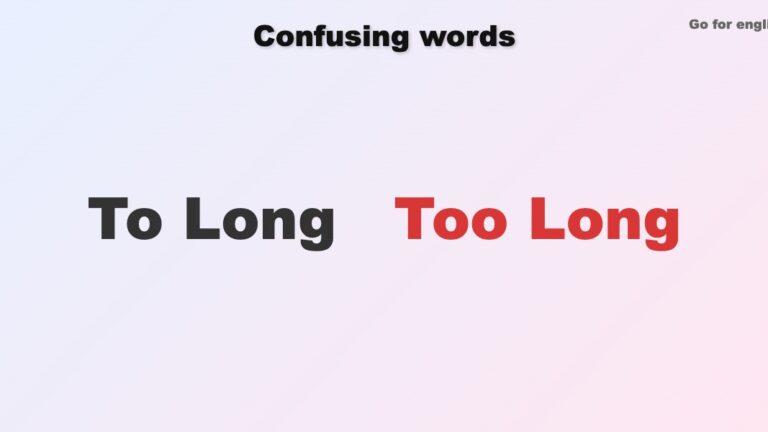
Many English learners often find themselves puzzled by the subtle differences between similar phrases, and the distinction between “to long” and “too long” is a prime example of this confusion. Grasping these nuances is crucial, as using the wrong phrase can lead to misunderstandings and affect the clarity of your communication. In this article, we will explore the meanings and uses of “to long” and “too long,” providing you with the knowledge needed to express your thoughts accurately and confidently. Let’s dive into the details that will clear up this common mix-up and enhance your English skills.
To Long vs. Too Long: A Quick Summary
“To long” is an incorrect phrase, while “too long” is the correct expression. “Too long” is an adverbial phrase used to indicate that something exceeds a certain length or duration, often implying that it is excessive or undesirable. For example, one might say, “The meeting lasted too long,” meaning it was longer than expected or preferred.
In contrast, “to” is a preposition that can indicate direction, place, or time but does not convey the idea of excess. Therefore, it is essential to use “too” when expressing that something is beyond acceptable limits. This usage is consistent in both American and British English, making it universally understood.
What Do ‘To Long vs Too Long’ Mean?
The terms “to long” and “too long” are often confused due to their similar pronunciation, but they serve different grammatical purposes in the English language. “To long” is not a standard phrase and typically does not appear in proper usage. Instead, the correct expression is “too long,” which is an adverbial phrase. It means an excessive length of time or distance. For instance, you might say, “The meeting lasted too long,” indicating that the duration exceeded what was considered reasonable or comfortable. Understanding the distinction between these phrases is crucial for effective communication in English.
‘To Long vs Too Long’: The Differences
The confusion between “to long” and “too long” highlights important differences in meaning and usage. While “too long” is universally accepted in both American and British English, “to long” lacks a defined meaning and is generally considered incorrect. In regional dialects, you might encounter variations in how people express length or duration, but “too long” remains the standard. For example, in American English, someone might say, “I waited too long for the bus,” while a British English speaker might phrase it similarly, emphasizing the excessive wait. This consistency underscores the importance of using “too long” correctly to ensure clarity and comprehension in communication.
Regional Preferences To Long vs Too Long
English is a dynamic language that varies significantly across different regions, reflecting unique cultural nuances and local usage. While the phrases To Long and Too Long may appear universally understood, their application can differ based on geographical context. The choice between these forms is influenced by the audience and the specific context in which they are used. Let’s delve into the regional differences to better understand their distinct usages.
American English
In American English, the phrase Too Long is more commonly used. For example, one might say, “This meeting is Too Long for my attention span.” Underneath this preference is the understanding that “too” indicates an excessiveness that is often emphasized in American communication style, making it a more relatable choice for speakers.
British English
Conversely, British English tends to favor To Long in specific contexts. An example sentence would be, “I find the film to be To Long for my taste.” This preference arises from a tendency in British English to use “to” in a more descriptive manner, indicating a subjective opinion rather than an excess, aligning with the more formal tone often associated with British communication.
Examples in Context To Long vs Too Long
Understanding the correct usage of “to long” and “too long” is crucial for effective communication in English. Real-life examples offer practical insights into how each term is used in different contexts, helping learners grasp the nuances between the two. By examining these examples, you will become more confident in distinguishing between “to long” and “too long” in your writing and conversations.
To Long
The phrase “to long” is often used in more specific contexts that relate to the infinitive form of a verb or as part of a larger expression. Here are some examples:
- I tend to long for the days when life was simpler.
- She seems to long for adventure and excitement.
- They began to long for a time when they could travel freely.
- He has learned to long for personal growth and self-improvement.
- Many people to long for connection in an increasingly digital world.
- She used to long for recognition in her career.
- It is natural to long for companionship during lonely times.
- He found it difficult to long for something he thought was unattainable.
Too Long
The phrase “too long” indicates an excessive duration or length of time, often implying that something is beyond what is desirable or acceptable. Here are some examples:
- The movie was too long, making it hard to stay engaged.
- My wait for the bus felt too long in the cold weather.
- She thought the meeting was too long and unproductive.
- He realized that his explanation was too long for the audience’s attention span.
- They decided the presentation was too long and needed to be condensed.
- After too long of a break, they were eager to resume their work.
- The email was too long to read in one sitting.
- It took too long to receive a response from customer service.
Synonyms & Antonyms of To Long vs Too Long
Understanding synonyms and antonyms is essential for enhancing your vocabulary and refining your language skills. Synonyms offer variety in both speech and writing, enabling you to express your thoughts in multiple ways. On the other hand, antonyms help clarify the precise meaning of a word, allowing for better communication. By familiarizing yourself with different word choices, you can sound more fluent and natural in English.
| Term | Synonyms | Antonyms |
|---|---|---|
| To Long | Desire, Crave, Yearn | Dislike, Reject, Abhor |
| Too Long | Excessively Long, Overlong, Prolonged | Short, Brief, Concise |
Common Mistakes and How to Avoid Them
Understanding common mistakes is essential for mastering the distinction between “to long” and “too long.” Even advanced learners can stumble over these nuances, and recognizing these errors can significantly enhance your fluency and accuracy in English. Let’s explore the frequent mistakes related to this topic and learn how to avoid them effectively.
- Mistake: Using “to long” instead of “too long.”
- Correction: Remember that “too” means “excessively” or “more than enough.” Use “too long” when describing something that exceeds the desired length.
- Mistake: Confusing “too long” with “to long” in written communication.
- Correction: Always double-check your writing. If you mean something is excessively long, use “too long.” “To” is a preposition and does not fit in this context.
- Mistake: Forgetting the context in which “too long” is used.
- Correction: Use “too long” when referring to time, distance, or any measurement that exceeds expectations, e.g., “The meeting was too long.” Context is crucial for clarity.
- Mistake: Overusing “too long” in informal settings.
- Correction: While informal language can be flexible, it’s best to use “too long” appropriately in both casual and formal contexts to maintain clarity.
- Mistake: Misunderstanding regional differences in usage.
- Correction: In all English-speaking regions, “too long” is the correct form. Be aware that some phrases may vary, but this distinction remains consistent.
Tips for Correct Usage
Mastering the correct usage of “to long” vs. “too long” is essential for clear and professional writing. Using these terms correctly not only enhances your grammatical accuracy but also improves the overall clarity of your message. Below are practical tips to help you navigate this common confusion with ease.
- Understand the Definitions: Remember that “too” means “excessively” or “more than needed,” while “to” is a preposition used to indicate direction or purpose.
- Use Context Clues: Pay attention to the context of your sentence. If you are describing something as excessive, “too” is the correct choice.
- Check for Common Mistakes: Be vigilant about confusing “to” and “too” in writing. Proofreading can help catch these errors before your work is published.
- Practice with Exercises: Engage in writing exercises that focus specifically on “to” and “too” to strengthen your understanding and usage.
- Consult Reliable Resources: Use grammar guides or reputable online resources when in doubt about usage, especially regional variations.
- Revise for Clarity: After writing, revise your work to ensure that you have used “too” and “to” correctly, as this can greatly enhance the clarity of your text.
- Ask for Feedback: Don’t hesitate to ask peers or educators to review your writing for correct usage of “to long” and “too long.”
Frequently Asked Questions
1. What is the difference between “to long” and “too long”?
“To long” is a common misspelling, while “too long” means something exceeds a desirable length.
2. How do you use “too long” in a sentence?
You can say, “The meeting was too long, and I lost my focus.”
3. Is “to long” a correct phrase in English?
No, “to long” is incorrect; the correct phrase is “too long.”
4. Can “too long” be used to describe time?
Yes, “too long” can describe time, such as in “The wait was too long.”
5. What are common mistakes with “too long”?
Common mistakes include writing “to long” or confusing “too” with “two” or “to.”
6. How do you remember the difference between “to” and “too”?
Remember that “too” means excessive, while “to” is used for direction or purpose.
7. Are there any synonyms for “too long”?
Yes, synonyms include “excessively long” or “overly long.”
8. Why is it important to use “too long” correctly?
Using “too long” correctly helps convey clear meaning and demonstrates proper language skills.