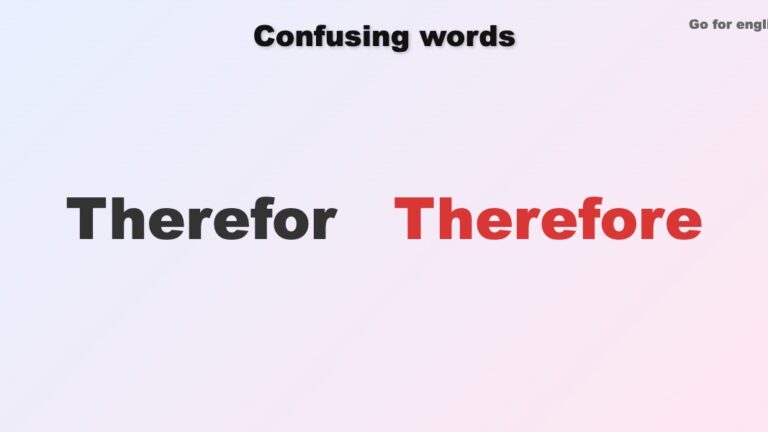
In the realm of written communication, the subtle nuances of language can often lead to confusion, particularly when it comes to words that sound similar but have distinct meanings. Take “therefor” and “therefore,” for example; many learners find themselves puzzled by these terms, unsure of when to use one over the other. Mastering the differences between these two words is crucial, as it not only enhances clarity in writing but also reflects a higher level of proficiency in the English language. In this article, we will unravel the distinctions between “therefor” and “therefore,” providing you with the insights needed to use them correctly and confidently in your own writing.
Therefor and therefore are often confused due to their similar spelling and pronunciation, but they have distinct meanings and uses. “Therefore” is a conjunction that means “for that reason” or “consequently,” and is commonly used to introduce a logical conclusion or inference. For example: “It was raining; therefore, we stayed indoors.” In contrast, “therefor” is a more archaic term that means “for that” or “for this,” and is seldom used in modern English. It is typically found in legal contexts or formal documents. While “therefore” is widely used in both American and British English, “therefor” is rare and generally not recommended for everyday usage.
What Do ‘Therefor vs Therefore’ Mean?
The terms ‘therefor’ and ‘therefore’ are often confused due to their similar spellings and pronunciations, but they serve distinct grammatical purposes. ‘Therefore’ is a conjunction that means ‘for that reason’ or ‘consequently.’ It is used to draw a conclusion based on the information that precedes it. For example, in the sentence, “It was raining heavily; therefore, the match was canceled,” ‘therefore’ connects the cause (the rain) with the effect (the cancellation of the match).
On the other hand, ‘therefor’ is a less common term that means ‘for that’ or ‘for this purpose.’ It is often used in legal or formal contexts. For instance, in a sentence like, “The payment is due therefor by the end of the month,” ‘therefor’ indicates that the payment is being made for a specific purpose or obligation.
‘Therefor vs Therefore’: The Differences
The primary difference between ‘therefor’ and ‘therefore’ lies in their usage and context. ‘Therefore’ is widely used in everyday language and is recognized in both American and British English. It is an essential part of writing and speech, making it a common choice for both formal and informal contexts.
In summary, while ‘therefore’ is versatile and widely applicable, ‘therefor’ is more specialized and less frequently used. Knowing when to use each term will not only improve your writing but also your overall command of the English language.
Regional Preferences Therefor vs Therefore
English is a diverse language that varies significantly across different regions, with unique preferences and nuances in usage. While the terms Therefor and Therefore may appear to be universally understood, regional differences exist that can influence their application. Choosing the correct form often depends on the audience and context, making it essential for English learners to be aware of these distinctions.
In American English, the usage of Therefore is prevalent in both written and spoken forms. For example: Therefore, we should consider alternative solutions to the problem. This form is preferred in the United States as it is more commonly used in formal writing and everyday conversation, making it the standard choice for clarity and professionalism.
In British English, however, Therefor is sometimes seen in more formal contexts, especially in legal or historical texts. For example: The funds were allocated to the project; therefor, we expect timely completion. In British English, this form is preferred in specific formal instances, as it aligns with traditional usages found in legal terminology and older literature.
Examples in Context: Therefor vs Therefore
Understanding the correct usage of “therefor” and “therefore” is essential for effective communication in English. Real-life examples play a crucial role in illustrating how each term is used in different contexts, providing practical insights that enhance comprehension. By examining these examples, learners will gain the confidence needed to distinguish between “therefor” and “therefore” in their writing and conversations.
Examples of Therefor
- The company issued a refund, and the customer received a credit therefor.
- The payment was made promptly, and therefor the service continued without interruption.
- She was awarded a scholarship; therefor, she could afford to attend her dream university.
- The contract specifies that the equipment should be delivered by Friday; therefor, we expect it to arrive on time.
- He signed the agreement, and therefor, he is bound by its terms.
- The funds were allocated for the project, therefor the team could begin work immediately.
- She passed all her exams, and therefor she will graduate this year.
- The organization received a grant; therefor, they were able to expand their outreach programs.
Examples of Therefore
- The weather forecast predicts rain; therefore, we should take an umbrella.
- The team worked hard on the project; therefore, they deserved the award.
- The results of the experiment were conclusive; therefore, we can proceed with the next phase.
- She studied diligently for the exam; therefore, she felt confident going in.
- The new policy has improved efficiency; therefore, we will implement it across all departments.
- He has extensive experience in the field; therefore, he was chosen for the leadership position.
- The meeting was rescheduled; therefore, please check your calendar for the new date.
- The data supports our hypothesis; therefore, we can publish our findings.
Synonyms & Antonyms of Therefor vs Therefore
Learning synonyms and antonyms is essential for enhancing your vocabulary and becoming a more effective communicator. Synonyms allow you to add variety to your speech and writing, making your language more engaging. On the other hand, antonyms help clarify the exact meaning of a word by providing contrasting terms, which can be particularly useful for nuanced understanding. By mastering different word choices, learners can sound more fluent and natural in English.
| Type | Word | Synonyms | Antonyms |
|---|---|---|---|
| Therefor | Therefor | For that, For it | None |
| Therefore | Therefore | Thus, Hence, Consequently | Nonetheless, However |
Common Mistakes and How to Avoid Them
Understanding common mistakes is crucial for mastering the use of “therefore” and “therefor.” Even advanced learners of English can confuse these terms, which can lead to misunderstandings and reduced fluency. By learning to recognize and correct these errors, you can improve both your writing and speaking accuracy.
- Using “therefor” instead of “therefore”: “Therefor” is a legal term meaning “for that” and is rarely used in everyday language. To avoid confusion, remember that “therefore” is used to indicate a conclusion or result. Example: “I studied hard; therefore, I passed the exam.”
- Incorrect spelling: Ensure you spell “therefore” correctly, as misspellings can change the meaning of your sentences. A quick spell check can help prevent this mistake.
- Confusing definitions: Understand that “therefore” connects ideas, while “therefor” refers to something specific in legal contexts. To avoid confusion, limit your use of “therefor” to formal or legal writing.
- Regional differences: Be aware that “therefor” may be more commonly used in legal contexts in some English-speaking regions. Always consider your audience; for general writing, stick with “therefore.”
- Overusing “therefore”: While it’s a strong linking word, avoid overusing it in your writing. Instead, consider synonyms like “thus” or “consequently” to vary your language and enhance readability.
Tips for Correct Usage
Mastering the correct usage of “therefor” vs “therefore” is crucial for effective writing. Using these terms accurately not only enhances the clarity of your message but also reflects professionalism and grammatical precision. Here are some practical tips to help you navigate these commonly confused terms.
- Understand the Definitions: “Therefore” is used to indicate a conclusion or result, while “therefor” refers to something that is intended for a particular purpose.
- Check the Context: Determine the role the word plays in the sentence. If you are showing cause and effect, use “therefore.” If you mean “for that,” opt for “therefor.”
- Avoid Common Mistakes: Do not confuse the two terms; using “therefore” in place of “therefor” (or vice versa) can lead to misunderstandings.
- Consistency is Key: Once you choose a term for your writing, stick to it throughout to maintain clarity and coherence.
- Review Regional Differences: Be aware that “therefor” is less commonly used and may vary in usage based on regional dialects or contexts.
- Seek Feedback: When in doubt, ask a peer or use grammar-checking tools to ensure proper usage.
Frequently Asked Questions
1. What is the difference between “therefore” and “therefor”?
“Therefore” is used to indicate a conclusion or result, while “therefor” refers to something that is meant or designated for a specific purpose, often in legal contexts.
2. How do you use “therefore” in a sentence?
You can use “therefore” to connect a cause and effect, as in: “It was raining; therefore, the event was canceled.”
3. Can “therefor” be used in everyday writing?
No, “therefor” is rarely used in everyday writing and is mostly found in legal or formal documents.
4. Is “therefore” a synonym for “thus”?
Yes, “therefore” and “thus” can often be used interchangeably to indicate a conclusion or result.
5. What are common mistakes with “therefore”?
Common mistakes include spelling it incorrectly as “there for,” using it inappropriately in casual contexts, or confusing it with “therefor.”
6. Are there any phrases that can replace “therefore”?
Phrases like “as a result,” “for that reason,” and “consequently” can be used in place of “therefore” without changing the meaning.
7. Is “therefor” commonly tested in grammar quizzes?
While “therefor” may not be frequently tested, understanding its specific use is important for clarity in formal writing.
8. How can I remember the difference between “therefore” and “therefor”?
One way to remember is that “therefore” has “there” plus “for,” indicating a conclusion, while “therefor” is more specialized and less commonly used.