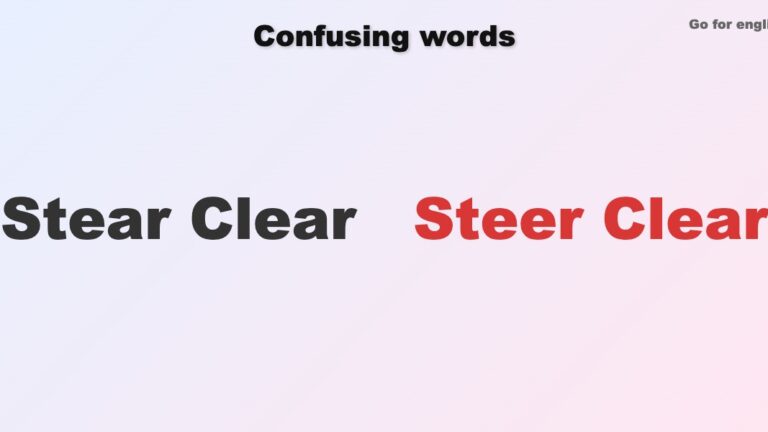
Navigating the nuances of the English language can often feel like a maze, especially when it comes to phrases that sound alike but carry distinct meanings, such as “Stear Clear” and “Steer Clear.” For language learners, grasping these subtle differences is essential, as using the wrong phrase can lead to misunderstandings and miscommunications. In this article, we will dissect both terms, clarify their meanings, and provide examples to ensure you can confidently use the correct phrase in any context. Let’s dive into the world of these commonly confused expressions!
Stear Clear vs Steer Clear: The phrase “steer clear” means to avoid something or to stay away from a particular situation or person that may be harmful or undesirable. For example, one might say, “You should steer clear of that area after dark.” In contrast, “stear clear” is a common misspelling of “steer clear” and has no recognized meaning in English. This distinction is crucial for clear communication, especially in written contexts. The correct form, “steer clear,” is used in both American and British English, with no regional variations. Understanding this difference helps learners avoid common errors and enhances their writing accuracy.
What Do ‘Stear Clear vs Steer Clear’ Mean?
The phrases “stear clear” and “steer clear” often cause confusion due to their similar pronunciation, but they have distinct meanings. The correct expression is “steer clear,” which means to avoid something or someone. The term “steer” acts as a verb, guiding or directing oneself away from something undesirable. For example, you might say, “I decided to steer clear of that restaurant after hearing the reviews.”
On the other hand, “stear clear” is a common misspelling of “steer clear.” It doesn’t hold any meaning in standard English usage. Therefore, when communicating effectively, it’s essential to use the correct phrase to convey your intention clearly.
‘Stear Clear vs Steer Clear’: The Differences
Understanding the differences between “stear clear” and “steer clear” can enhance your English proficiency, especially when considering regional variations. The correct term “steer clear” is widely accepted in both American and British English, while “stear clear” is generally viewed as an error.
In American English, “steer clear” is commonly used in both spoken and written contexts. For example, someone might say, “You should steer clear of that part of town after dark.” In British English, the phrase is equally prevalent, often used in similar contexts. However, it is essential to note that using the incorrect spelling “stear clear” may be encountered in informal settings, but it is best avoided in formal writing.
By using the correct phrase, “steer clear,” you not only ensure clarity in your communication but also demonstrate a strong command of the English language.
Regional Preferences: Stear Clear vs Steer Clear
English is a dynamic language that varies significantly across different regions, reflecting the diverse cultures and histories of its speakers. While the phrases Stear Clear and Steer Clear may seem universally understood, they exhibit regional differences in usage that can affect communication. Choosing the correct form often depends on the audience and context, so it’s essential to be aware of these nuances as we explore the distinctions between American and British English.
American English
In American English, the correct usage is Steer Clear. For example, one might say, “You should always steer clear of dangerous neighborhoods.” In the United States, this version is more commonly used because it aligns with the metaphor of steering a vehicle away from hazards, making it a familiar and relatable expression.
British English
Conversely, in British English, the preferred form is Stear Clear. An example sentence is, “It’s wise to stear clear of any political debates at family gatherings.” In British English, this form is preferred as it reflects certain regional linguistic rules and traditions that have evolved over time, creating a distinct variation in expression.
Examples in Context: Stear Clear vs Steer Clear
Understanding the correct usage of “stear clear” and “steer clear” is crucial for effective communication in English. Real-life examples shed light on how these terms are used in different contexts, providing practical insights that help learners confidently distinguish between them. By examining these examples, you will enhance your ability to use “stear clear” and “steer clear” accurately in both writing and conversations.
Stear Clear
It’s important to note that “stear clear” is often a common misspelling of “steer clear.” However, for the sake of this exercise, we will provide examples where “stear clear” might appear in informal contexts:
- Many people mistakenly believe that they should stear clear of all criticism.
- When it comes to politics, I always try to stear clear of heated debates.
- To maintain a good reputation, it’s best to stear clear of gossip.
- She advised her friends to stear clear of the risky investment.
- On social media, it’s wise to stear clear of controversial topics.
- He decided to stear clear of the drama that often surrounds her.
- In order to stay focused, I try to stear clear of distractions.
- They learned to stear clear of places that could lead to trouble.
Steer Clear
- It’s best to steer clear of the busy streets during rush hour.
- To avoid a confrontation, you should steer clear of sensitive subjects.
- He advised her to steer clear of that part of town at night.
- During flu season, it’s wise to steer clear of crowded places.
- To maintain a healthy lifestyle, I try to steer clear of junk food.
- She learned to steer clear of negative influences in her life.
- When hiking, always steer clear of unstable rocks.
- To avoid misunderstandings, it’s best to steer clear of ambiguous language.
Synonyms & Antonyms of Stear Clear vs Steer Clear
Expanding your vocabulary by learning synonyms and antonyms is crucial for effective communication in English. Synonyms enrich your speech and writing, allowing you to express ideas with variety and creativity. On the other hand, antonyms provide clarity by highlighting the opposite meanings of words, which helps in grasping the nuances of language. By understanding different word choices, learners can enhance their fluency and sound more natural in conversations. Below is a table listing synonyms and antonyms for the phrases “stear clear” and “steer clear.”
| Phrase | Synonyms | Antonyms |
|---|---|---|
| Stear Clear | None (incorrect usage) | None (incorrect usage) |
| Steer Clear | Avoid, Stay away from, Keep away from | Approach, Engage, Confront |
Common Mistakes and How to Avoid Them
Understanding the distinction between “Stear Clear” and “Steer Clear” is crucial for mastering English fluency. Even advanced learners can confuse these phrases, leading to miscommunication. By identifying and correcting these common mistakes, you can enhance your accuracy and confidence in English usage.
- Common Mistake: Using “Stear Clear” instead of “Steer Clear.”
- Correction: Remember that “Steer Clear” means to avoid something. Use “steer” like you would in driving a vehicle. “Stear” is a misspelling.
- Common Mistake: Misunderstanding the context of “Steer Clear.”
- Correction: Use “Steer Clear” when advising someone to avoid danger or trouble. For example, “You should steer clear of that area at night.”
- Common Mistake: Confusing “Steer Clear” with similar phrases.
- Correction: Familiarize yourself with synonyms like “avoid,” “stay away from,” or “shun.” This will enhance your vocabulary and contextual understanding.
- Common Mistake: Regional usage variations.
- Correction: While “Steer Clear” is universally accepted in English-speaking regions, ensure you are aware of the context to maintain clarity in communication.
- Common Mistake: Overusing the phrase in formal writing.
- Correction: In formal contexts, consider using alternatives like “avoid” or “refrain from” to enhance the sophistication of your writing.
Tips for Correct Usage
Mastering the correct usage of “Stear Clear” vs. “Steer Clear” is essential for enhancing clarity, professionalism, and grammatical accuracy in your writing. Using these phrases correctly not only boosts your credibility but also ensures your message is understood. Below are practical writing tips to help you use “Steer Clear” correctly in your communications.
- Remember the meaning: “Steer clear” means to avoid something or someone. “Stear” is a common misspelling.
- Check your spelling: Always spell it “steer” when referring to avoiding something.
- Use in context: Employ “steer clear” in both formal and informal settings to convey avoidance clearly.
- Be mindful of regional usage: While “steer clear” is universally understood, some phrases may vary regionally; ensure your audience understands.
- Avoid redundancy: Don’t say “steer clear of avoid” as it can be redundant; choose one term for clarity.
- Proofread: Always proofread your work to catch spelling errors, especially with commonly confused words.
- Seek feedback: If unsure, ask peers to review your usage for any potential misunderstandings.
Frequently Asked Questions
What is the difference between ‘Stear Clear’ and ‘Steer Clear’?
‘Steer Clear’ is the correct phrase meaning to avoid something, while ‘Stéar Clear’ is a common misspelling that has no meaning.
How do you use ‘Steer Clear’ in a sentence?
You can use ‘Steer Clear’ in a sentence like this: “I always steer clear of fast food for my health.”
Is ‘Stear Clear’ a valid phrase?
No, ‘Stear Clear’ is not valid and is often a typographical error. The correct phrase is ‘Steer Clear.’
Can ‘Steer Clear’ be used in informal contexts?
Yes, ‘Steer Clear’ can be used in both formal and informal contexts to signify avoidance.
What does ‘Steer Clear’ imply?
‘Steer Clear’ implies the action of deliberately avoiding someone or something that may be harmful or undesirable.
Are there any synonyms for ‘Steer Clear’?
Yes, synonyms for ‘Steer Clear’ include ‘avoid,’ ‘stay away from,’ and ‘keep clear of.’
Is there a grammatical rule for using ‘Steer Clear’?
There are no specific grammatical rules for using ‘Steer Clear’; it functions as a verb phrase and can be used in various tenses.
Why do people confuse ‘Stear Clear’ with ‘Steer Clear’?
The confusion often arises from the similarity in pronunciation, leading to common misspellings like ‘Stear Clear.’