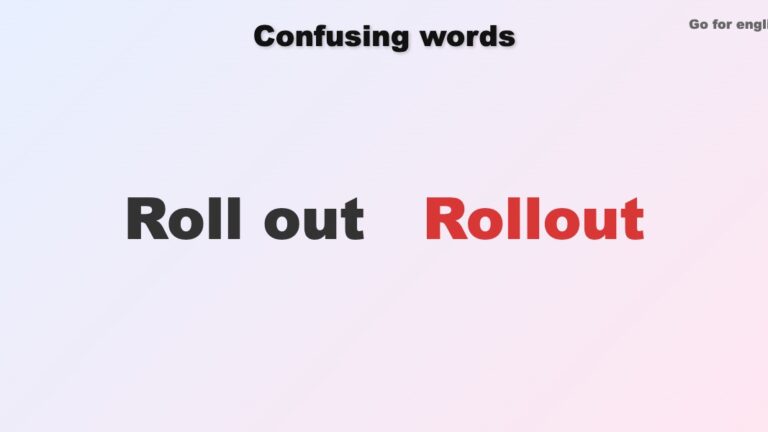
In the world of English, even the smallest variations in spelling can lead to significant confusion, and the terms “roll out” and “rollout” are prime examples of this linguistic puzzle. For learners, grasping the distinction between these two forms is essential, as it can enhance clarity in both written and spoken communication. Whether you’re crafting a business proposal or engaging in casual conversation, using the correct term can make all the difference in conveying your message effectively. Let’s dive into the nuances of “roll out” versus “rollout” and explore how to use each one correctly in your writing.
Roll out (two words) is a verb phrase that means to launch or implement something, typically a new product, service, or plan. For example, a company might “roll out” a new marketing strategy.
Rollout (one word) is a noun that refers to the process or event of launching something. It describes the actual occasion or method of implementing a new initiative, such as a “rollout of new software.”
In terms of usage, “roll out” is often used in a more active context, while “rollout” serves as a noun to describe the event or process. In American English, both forms are commonly used, whereas British English tends to prefer “roll out” as a verb and may also use “roll-out” (with a hyphen) as a noun.
In summary, use “roll out” when referring to the action of launching, and “rollout” when discussing the event or process of that launch.
What Do ‘Roll out vs Rollout’ Mean?
The terms ‘roll out’ and ‘rollout’ are often used interchangeably in everyday language, but they have distinct grammatical roles. ‘Roll out’ is a verb phrase that describes the action of deploying or introducing something, typically a new product, service, or plan. For example, you might say, “The company will roll out its new software update next week.” In this sentence, ‘roll out’ conveys the action of launching the update.
On the other hand, ‘rollout’ is a noun that refers to the act or process of rolling something out. It encapsulates the entire event or procedure involved in the deployment. For instance, you could say, “The rollout of the new feature was met with enthusiasm from users.” Here, ‘rollout’ signifies the event of introducing the new feature, highlighting its significance as a process rather than an action.
‘Roll out vs Rollout’: The Differences
While ‘roll out’ and ‘rollout’ may seem similar, their usage can vary slightly based on context, regional preferences, and stylistic choices. In American English, ‘rollout’ is commonly used as a noun, while ‘roll out’ remains the preferred verb form. For example, one might say, “We plan to roll out the marketing campaign in phases,” emphasizing the action, and “The rollout will take place over several months,” focusing on the event.
In British English, both forms are understood, but ‘roll out’ might be more frequently used in conversational contexts. An example could be, “They will roll out the new regulations soon,” versus “The rollout of the new regulations was delayed.” This distinction shows not only a grammatical difference but also a slight variation in usage that reflects regional language patterns.
Understanding the differences between ‘roll out’ and ‘rollout’ is essential for clear and effective communication, especially in professional settings where precision matters. By recognizing these terms, you can enhance your writing and ensure your message is conveyed accurately.
Regional Preferences: Roll out vs Rollout
English, as a global language, exhibits a fascinating diversity influenced by regional dialects and cultural nuances. One area where this variation is particularly noticeable is in the terms “Roll out” and “Rollout.” While they may appear interchangeable at first glance, their usage can differ significantly based on audience and context. Understanding these regional preferences is essential for effective communication.
American English
In the United States, the term **Roll out** is commonly employed in both casual and formal contexts. For example, “The company plans to **Roll out** the new software next month.”
In American English, this version is more commonly used because it aligns with the trend of using phrasal verbs that convey action clearly and directly, reflecting a preference for dynamic language in everyday communication.
British English
Conversely, in British English, the term **Rollout** is often favored, as in, “The government announced the **Rollout** of the vaccination program.”
In British English, this form is preferred, as it follows the convention of treating compound nouns as single entities, which enhances clarity and formality in written text.
Examples in Context: Roll out vs Rollout
Understanding the distinction between “roll out” and “rollout” is crucial for effective communication. Real-life examples enhance our grasp of these terms, illustrating their unique contexts and uses. By examining these examples, learners can confidently differentiate between “roll out” and “rollout” in both writing and conversations.
Roll Out
1. The company plans to roll out the new software update next month to improve user experience.
2. After thorough testing, the team is ready to roll out the marketing campaign in several key markets.
3. The school will roll out a new curriculum designed to enhance student engagement and learning.
4. We are excited to roll out our latest product at the annual tech conference.
5. The government intends to roll out new health guidelines to ensure public safety during the pandemic.
6. As part of the initiative, they will roll out training sessions for all employees.
7. The charity aims to roll out its services to underserved communities across the region.
8. The restaurant is set to roll out its seasonal menu next week, featuring local ingredients.
Rollout
1. The rollout of the new operating system was met with mixed reviews from users.
2. The project manager outlined the timeline for the rollout of the new features.
3. A successful rollout requires careful planning and coordination among all teams involved.
4. Feedback from the initial rollout indicated several areas for improvement.
5. The rollout of the vaccine program has been swift and efficient across the nation.
6. During the rollout, the company experienced some technical difficulties that needed addressing.
7. Experts suggest that a phased rollout will minimize disruption for existing users.
8. The marketing team’s strategy for the rollout was detailed in the quarterly report.
Synonyms & Antonyms of Roll out vs Rollout
Learning synonyms and antonyms is essential for improving vocabulary and enhancing communication skills. Synonyms offer a variety of options that make speech and writing more engaging, while antonyms help to clarify the meaning of a word by providing contrasting terms. Mastering different word choices not only enriches your language but also allows you to sound more fluent and natural in English. Below is a table that lists synonyms and antonyms for “roll out” and “rollout.”
| Term | Synonyms | Antonyms |
|---|---|---|
| Roll out | Launch, Implement, Introduce, Unveil | Withdraw, Revoke, Cancel, Abandon |
| Rollout | Launch, Deployment, Release, Distribution | Retraction, Withdrawal, Discontinuation, Recall |
Common Mistakes and How to Avoid Them
Understanding common mistakes in English is crucial for mastering nuances like “Roll out” vs “Rollout.” Even advanced learners can trip over these terms, and correcting such errors enhances both fluency and accuracy in communication. Below are the most frequent mistakes associated with these terms, along with actionable recommendations to avoid them.
- Mistake: Using “Rollout” as a verb.
- Correction: Remember that “Rollout” is a noun referring to the launch of a product or service. Use “Roll out” as a verb phrase to indicate the action of introducing something.
- Mistake: Confusing “Roll out” and “Rollout” in formal writing.
- Correction: In formal contexts, always use “Rollout” when referring to the noun form and “Roll out” when describing the action. This distinction maintains clarity in your writing.
- Mistake: Misusing “Rollout” in different contexts.
- Correction: Ensure you’re using “Rollout” in appropriate scenarios, such as business strategies or technology launches. Avoid using it in casual contexts where “Roll out” might be more fitting.
- Mistake: Ignoring regional variations.
- Correction: Be aware that “Rollout” is more commonly used in American English, while “Roll out” is universally accepted. Adjust your usage based on your audience’s location.
- Mistake: Overusing “Rollout” in conversation.
- Correction: Use “Roll out” in everyday speech for a more natural flow. Reserve “Rollout” for written communication, especially in business or technical contexts.
Tips for Correct Usage
Mastering the correct usage of “roll out” vs. “rollout” is essential for effective communication in writing. Using these terms accurately not only enhances clarity but also reflects professionalism and grammatical precision. Below are practical tips to help you navigate the differences and use these terms appropriately.
- Understand the Definitions: “Roll out” is a verb phrase meaning to launch or deploy something, while “rollout” is a noun referring to the act of launching or the process itself.
- Use “Roll out” in Verb Form: When describing the action of implementing a new product or service, always use “roll out.” For example, “We will roll out the new software next month.”
- Use “Rollout” as a Noun: When referring to the event or process, use “rollout.” For example, “The rollout was successful and well-received.”
- Be Consistent: Choose one term based on the context and use it consistently throughout your writing to avoid confusion.
- Consider Regional Variations: Be aware that some regions may have preferences for one term over the other, especially in business contexts. Research your audience’s preferences.
- Avoid Common Mistakes: Do not interchange “rollout” and “roll out.” This is a frequent error that can lead to miscommunication.
- Proofread for Clarity: After writing, review your work to ensure that you have used “roll out” and “rollout” correctly based on their grammatical roles.
Frequently Asked Questions
What is the difference between “roll out” and “rollout”?
“Roll out” is a verb phrase meaning to launch or introduce something, while “rollout” is a noun referring to the process or event of launching.
Is “rollout” a single word or two words?
Can “roll out” be used in any context?
Yes, “roll out” can be used in various contexts, such as technology, business, or even casual conversations to indicate the introduction of something new.
How do I use “rollout” in a sentence?
You can use “rollout” in a sentence like this: “The company announced the rollout of its new software next month.”
Are “roll out” and “rollout” interchangeable?
No, “roll out” and “rollout” are not interchangeable; use “roll out” when describing the action and “rollout” when referring to the event itself.
What does “roll out” mean in business?
In business, “roll out” refers to the process of launching a new product, service, or initiative to the market.
Is “rollout” used in formal writing?
Yes, “rollout” is commonly used in formal writing, especially in business and technology contexts, to describe a planned introduction or launch.
What are some synonyms for “roll out”?
Some synonyms for “roll out” include “launch,” “introduce,” and “deploy,” depending on the context.