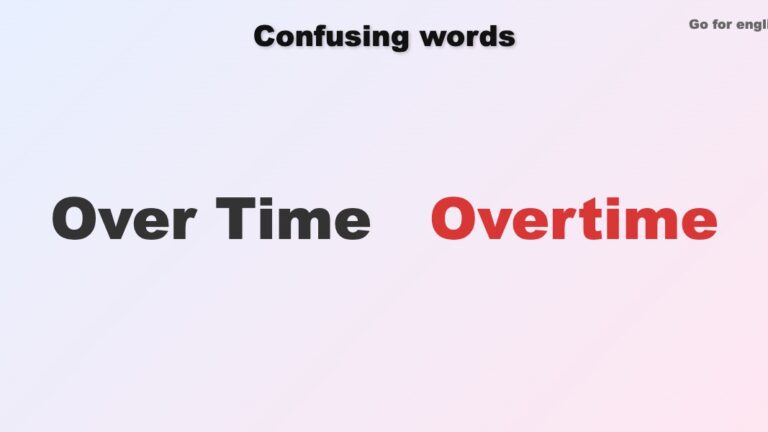
Many English learners find themselves puzzled by the nuances of similar phrases, and the distinction between “Over Time” and “Overtime” is no exception. Grasping the difference between these two terms is crucial, especially in contexts where precise language can significantly impact meaning. Whether you’re discussing gradual change in a broader sense or referring to additional hours worked beyond the standard schedule, understanding these terms can enhance your communication skills and avoid potential misunderstandings. In this article, we will clarify the definitions and usages of “Over Time” and “Overtime,” helping you navigate these commonly confused expressions with confidence.
Over Time and Overtime are two phrases that are often confused due to their similar spelling and pronunciation, but they have distinct meanings and usages.
Over Time refers to a gradual change or progression that occurs as time passes. It is commonly used in contexts such as personal growth, changes in trends, or the development of skills. For example, “Her confidence improved over time.”
Overtime, on the other hand, specifically relates to the additional hours worked beyond the standard work schedule, often implying extra pay. It is frequently used in employment contexts, especially in American English, such as, “He earned extra money by working overtime.”
In summary, over time denotes a process that unfolds gradually, while overtime pertains to extra work hours. Understanding the distinction is crucial for clear communication, particularly in professional settings.
What Do ‘Over Time vs Overtime’ Mean?
In English, the phrases “over time” and “overtime” serve distinct purposes and meanings, making it crucial to understand their differences. “Over time” is an adverbial phrase that indicates a gradual change or process occurring across an extended period. For example, one might say, “Over time, his skills improved significantly.” In this context, it suggests that the improvement was not immediate but developed gradually.
On the other hand, “overtime” is a noun that typically refers to the additional hours worked beyond the standard work schedule. For instance, you might hear, “She earned extra money by working overtime last weekend.” Here, “overtime” signifies the extra hours she worked, highlighting its importance in employment and labor discussions.
‘Over Time vs Overtime’: The Differences
While “over time” and “overtime” may sound similar, their usage varies significantly, and this can lead to confusion. In American English, “overtime” is commonly associated with labor laws and pay structures, emphasizing the hours worked beyond the typical workweek, often accompanied by higher pay rates. In contrast, “over time” is universally understood and used in both American and British English to denote a gradual process.
Interestingly, in British English, the term “overtime” retains the same meaning as in American English, but the phrase “over time” can also be used in contexts discussing historical changes or trends. For example, “Over time, the city transformed from a small town into a bustling metropolis” illustrates a gradual evolution that transcends regional differences.
In summary, while “over time” refers to a gradual progression, “overtime” specifically pertains to extra work hours. Understanding these nuances helps ensure clear communication and proper usage of these terms in various contexts.
Regional Preferences Over Time vs Overtime
English is a dynamic language that varies significantly across different regions, influenced by cultural contexts and linguistic evolution. While “Over Time” and “Overtime” may seem universally understood, there are notable regional differences in their usage. Choosing the correct form often depends on your audience and the context in which you are writing. Understanding these regional preferences can enhance your communication effectiveness.
American English
In American English, the term Over Time is frequently used in contexts referring to gradual change or development. For example: “The company has improved its profits over time.”
In the United States, this version is more commonly used because it emphasizes the process of change and is often used in discussions related to growth and progress.
British English
Conversely, in British English, the term Overtime is more prevalent, particularly in contexts involving work hours. For instance: “She earned extra pay for working overtime last weekend.”
In British English, this form is preferred as it specifically refers to hours worked beyond the standard work period, aligning with local labor terminology.
Examples in Context: Over Time vs Overtime
Understanding the distinction between “over time” and “overtime” is crucial for effective communication. Real-life examples illuminate how each term is applied in various contexts, offering practical insights that enhance comprehension. By examining these examples, learners will gain the confidence to distinguish between “over time” and “overtime” in both writing and conversation.
Over Time
- She developed her skills over time, becoming an expert in her field.
- Over time, the city transformed from a small town into a bustling metropolis.
- His understanding of the subject deepened over time as he engaged with different perspectives.
- Over time, the relationship between the two countries improved significantly.
- The project evolved over time, reflecting the team’s growing experience.
- Over time, many people have come to realize the importance of mental health.
- Her health improved over time with consistent exercise and a balanced diet.
- The technology has changed dramatically over time, impacting how we communicate.
Overtime
- The employees were required to work overtime to meet the project deadline.
- She received extra pay for the overtime hours she worked last week.
- During the busy season, many workers voluntarily take on overtime shifts.
- His overtime pay significantly boosted his monthly income.
- They implemented a new policy regarding overtime to ensure fair distribution of hours.
- He was exhausted after working several consecutive days of overtime.
- The company encourages overtime for those who want to earn extra money.
- Overtime can lead to burnout if not managed properly.
Synonyms & Antonyms of Over Time vs Overtime
Learning synonyms and antonyms is essential for enhancing vocabulary and communication skills in English. Synonyms allow for variety in speech and writing, enriching the language and preventing repetition. On the other hand, antonyms help clarify the exact meaning of a word, providing contrast that is crucial for precise understanding. By expanding their knowledge of different word choices, learners can sound more fluent and natural in their English conversations. Below is a table that lists the synonyms and antonyms for “over time” and “overtime.”
| Term | Synonyms | Antonyms |
|---|---|---|
| Over Time | Gradually, Eventually, In the long run | Instantly, Immediately |
| Overtime | Extra hours, Additional time, Extended hours | Regular hours, Standard time |
Common Mistakes and How to Avoid Them
Understanding common mistakes is essential for mastering the terms “over time” and “overtime.” Even advanced learners can confuse these phrases, which can impact their fluency and accuracy in English. By learning to correct these mistakes, you can enhance your communication skills and ensure clarity in your writing.
- Mistake: Using “overtime” to refer to a gradual process.
Correction: Use “over time” when discussing gradual changes or developments, such as “Over time, her skills improved significantly.” - Mistake: Confusing “over time” with “overtime” in a work context.
Correction: Use “overtime” to refer to extra hours worked beyond the normal schedule, like “He earned extra pay for working overtime.” - Mistake: Using “overtime” in non-work related contexts.
Correction: Reserve “overtime” strictly for work scenarios. In other contexts, stick with “over time” to describe processes or changes. - Mistake: Misplacing the phrase in sentences.
Correction: Ensure that “over time” is used to describe a duration, e.g., “The project evolved over time,” while “overtime” should be positioned in work-related discussions, e.g., “They are paid overtime for additional hours.” - Mistake: Ignoring regional differences.
Correction: Be aware that in British English, “overtime” may be more commonly used in various contexts. However, the distinction between “over time” and “overtime” remains consistent.
Tips for Correct Usage
Mastering the correct usage of “over time” vs. “overtime” is crucial for clear and professional writing. Using these terms accurately not only enhances your grammatical precision but also ensures your message is easily understood by your audience. Below are practical tips to help you distinguish between these two commonly confused phrases.
- Understand Definitions: Remember that “over time” refers to a duration or period, while “overtime” typically relates to extra hours worked or payment for those hours.
- Use Context Clues: Pay attention to the context in which you are writing. If discussing time passing, use “over time”; if referring to work hours, use “overtime.”
- Check for Adjectives: “Overtime” can function as an adjective (e.g., overtime pay). Ensure you recognize when you need a descriptive form.
- Avoid Common Mistakes: Don’t use “overtime” when referring to a gradual change or development; reserve it for employment contexts.
- Be Mindful of Regional Variations: While both terms are widely understood in English, “overtime” is more commonly used in American English, whereas “over time” is universally applicable.
- Proofread for Clarity: During editing, double-check your use of “over time” and “overtime” to ensure they fit the context of your sentences.
- Practice with Examples: Create sentences using both terms to reinforce their differences, even if you don’t use them in your final draft.
Frequently Asked Questions
What is the difference between “over time” and “overtime”?
“Over time” refers to the passage of time, while “overtime” specifically denotes additional hours worked beyond the standard work schedule, often entailing extra pay.
When should I use “over time”?
Use “over time” when discussing the gradual progression of time or changes that occur as time passes.
When is “overtime” applicable in a work context?
“Overtime” is applicable when an employee works more than their standard hours, usually qualifying them for higher pay rates according to labor laws.
Can “overtime” be used in a non-work context?
No, “overtime” is primarily a workplace term, whereas “over time” can be used in various contexts, such as personal growth or historical changes.
How do I remember the difference between “over time” and “overtime”?
Remember that “over time” has a space and relates to the concept of time itself, while “overtime” is a combined word specifically related to additional work hours.
Is “overtime” always compensated with extra pay?
In most cases, yes, but it ultimately depends on the company policy and local labor laws regarding overtime compensation.
Are there any synonyms for “overtime”?
Some synonyms for “overtime” include “extra hours,” “additional time,” and “extended hours,” but they may not carry the same legal implications.
Can “over time” be used in a legal context?
Yes, “over time” can be used in legal contexts to describe developments or changes that occur as time progresses, but it does not refer to work hours.