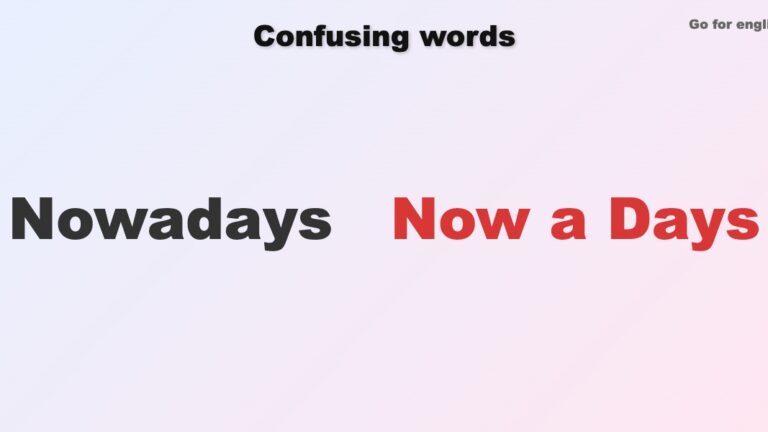
The English language is filled with nuances that can trip up even the most seasoned learners, and the distinction between “nowadays” and “now a days” is a prime example. Many people find themselves puzzled by this seemingly simple phrase, often using them interchangeably without realizing that they convey different meanings and uses. Understanding this difference is crucial for effective communication, as it not only enhances your vocabulary but also sharpens your writing skills. In this article, we’ll dive into the definitions, usages, and examples of “nowadays” and “now a days,” helping you navigate these terms with confidence and clarity.
Nowadays is an adverb that means “at the present time” or “these days.” It is commonly used to refer to current situations, trends, or phenomena. For example, “Nowadays, people rely heavily on technology for communication.”
Now a days is often mistakenly used as a variation of “nowadays,” but it is not considered standard English. The phrase can be broken down into “now” and “a days,” which suggests a more informal or incorrect usage. It may appear in casual conversations but should be avoided in formal writing.
In summary, “nowadays” is the correct term to use, while “now a days” is not standard and may be seen as incorrect in both American and British English.
What Do ‘Nowadays vs Now a Days’ Mean?
The terms “nowadays” and “now a days” often cause confusion among English learners, but they actually refer to the same concept of the present time. “Nowadays” is a single word and is widely accepted in both spoken and written English. It functions as an adverb, meaning “at the present time” or “in these times.” For example, you might say, “Nowadays, many people prefer to work from home.”
On the other hand, “now a days” is a less common and somewhat outdated variant of the same phrase. It is often seen as incorrect or informal and can be misunderstood as two separate words, which is not the standard usage in contemporary English. A sentence using this form could be, “Now a days, children spend more time on screens than playing outside,” though it is advisable to stick with “nowadays” for clarity and correctness.
‘Nowadays vs Now a Days’: The Differences
While “nowadays” is the preferred and standard form in English, “now a days” is often used incorrectly or in a very casual context. This distinction is important not only in terms of grammatical correctness but also in understanding regional preferences. In American English, for instance, “nowadays” is the overwhelmingly accepted term, while “now a days” may occasionally appear in informal speech or writing but is generally frowned upon.
In British English, the situation is similar; “nowadays” is the correct choice, and “now a days” is rarely seen in formal writing. Using “nowadays” is more likely to be understood and appreciated by a wider audience, ensuring clear communication. For example, one might say, “Nowadays, environmental awareness has grown significantly,” which showcases the term’s correct usage in context.
In summary, when discussing the present time, it is best to use “nowadays” for clear, formal, and correct communication, while “now a days” should be avoided due to its informal and less recognized status in modern English.
Regional Preferences: Nowadays vs Now a Days
English is a dynamic language that varies significantly across different regions, influenced by local cultures and historical developments. While the phrases Nowadays and Now a Days may appear to be universally understood, their usage can differ based on geographic location. Choosing the correct form is essential, as it often depends on the audience and context in which the language is being used. Let’s explore how these two forms are employed in various English-speaking regions.
American English
In the United States, the phrase Nowadays is commonly used in everyday conversation. For example, one might say, “People seem to be more health-conscious nowadays.” This preference is favored because it reflects a modern and streamlined approach to language, which resonates with American communication styles that often prioritize brevity and clarity.
British English
In contrast, British English often leans toward the expression Now a Days, especially in more formal contexts. An example would be, “The views on climate change have shifted greatly now a days.” This usage is preferred as it aligns with traditional linguistic patterns in British English, where multi-word phrases can add a layer of emphasis and formality to discussions.
Examples in Context Nowadays vs Now a Days
Understanding the correct usage of “nowadays” and “now a days” is crucial for effective communication. Real-life examples serve as practical insights into how each term is applied in different contexts. By exploring these examples, learners can confidently distinguish between “nowadays” and “now a days” in their writing and conversations.
Examples of “Nowadays”
- Nowadays, many people prefer to work from home instead of commuting to an office.
- It seems that nowadays, children are more engaged with technology than ever before.
- People nowadays often choose to communicate through social media rather than face-to-face.
- In the world of fashion, trends change rapidly nowadays.
- Nowadays, it’s common for students to rely on online resources for their studies.
- Many families are choosing to eat healthier meals nowadays.
- Nowadays, environmental awareness is more important than ever.
- The way we consume news has changed a lot nowadays, thanks to the internet.
Examples of “Now a Days”
- Now a days, he prefers to spend his weekends hiking instead of watching movies.
- We often find it hard to meet up with friends now a days due to our busy schedules.
- Now a days, I try to read at least one book each month to improve my knowledge.
- It seems that people don’t write letters as much now a days.
- Now a days, finding a job can be quite competitive.
- People have different priorities now a days compared to a decade ago.
- Now a days, many students are balancing part-time jobs with their studies.
- It’s important to stay informed about global issues now a days.
Synonyms & Antonyms of Nowadays vs Now a Days
Learning synonyms and antonyms is crucial for enhancing your vocabulary in English. Synonyms offer variety in your speech and writing, allowing you to express your ideas more creatively. On the other hand, antonyms help clarify the specific meaning of a word, giving you a deeper understanding of its usage. By expanding your word choices, you can sound more fluent and natural in English conversations and writings.
Below is a table listing the synonyms and antonyms for “nowadays” and “now a days”:
| Term | Synonyms | Antonyms |
|---|---|---|
| Nowadays | Currently, At present, These days | In the past, Formerly |
| Now a Days | Currently, At present, These days | In the past, Formerly |
Common Mistakes and How to Avoid Them
Understanding the differences between “nowadays” and “now a days” is crucial for mastering English. Even advanced learners sometimes struggle with these terms, leading to confusion in both writing and speaking. By learning to recognize and correct these common mistakes, you can enhance your fluency and accuracy in English.
- Mistake: Using “now a days” instead of “nowadays”.
Correction: “Nowadays” is a single word meaning “at the present time”. Avoid separating it into two words. - Mistake: Confusing the meaning of “nowadays” with “these days”.
Correction: While both phrases can mean the current period, “nowadays” is often used in more formal contexts. Choose based on the tone of your writing. - Mistake: Misplacing “nowadays” in a sentence.
Correction: “Nowadays” typically appears at the beginning or end of a sentence. For example, “Nowadays, many people work from home.” or “Many people work from home nowadays.” - Mistake: Using “now a days” in casual conversation.
Correction: Always use “nowadays” in both spoken and written English to maintain correctness and clarity. - Mistake: Overusing “nowadays” in every context.
Correction: Vary your vocabulary. Use alternatives like “currently” or “at the moment” to avoid repetition.
Tips for Correct Usage
Mastering the correct usage of “nowadays” and “now a days” is essential for clear and professional writing. Using these terms accurately not only enhances your grammatical precision but also improves your overall communication. Below are practical writing tips to help you navigate these terms effectively.
- Understand the Definitions: “Nowadays” refers to the present time, whereas “now a days” is incorrect in standard usage.
- Use “nowadays” as an Adverb: Always use “nowadays” as a single adverb to describe current times or trends.
- Avoid the Space: Never separate “now” and “a days”; this form does not exist in standard English.
- Check for Context: Ensure that the context of your sentence supports the use of “nowadays” to convey present-day relevance.
- Be Aware of Regional Variations: While “nowadays” is universally accepted, be aware of regional preferences in English for other similar terms.
- Revise for Clarity: If in doubt, rewrite your sentence to eliminate ambiguity around time references instead of using “nowadays.”
- Proofread for Errors: Always proofread your writing to catch any incorrect usage of “nowadays” or any potential typos.
Frequently Asked Questions
What is the difference between “nowadays” and “now a days”?
“Nowadays” is an adverb meaning “at the present time.” “Now a days,” which is incorrect in standard English, is often mistakenly used instead of “nowadays.”
How do you use “nowadays” in a sentence?
You can use “nowadays” to refer to current trends or situations, for example, “Nowadays, many people work from home.”
Is “now a days” correct English?
No, “now a days” is not considered correct English; the correct term is “nowadays,” which is written as one word.
Can “nowadays” be used in formal writing?
Yes, “nowadays” is appropriate for both informal and formal writing contexts.
Is there a synonym for “nowadays”?
Yes, synonyms for “nowadays” include “currently,” “at present,” and “these days.”
Why is “nowadays” preferred over “now a days”?
“Nowadays” is the standard and widely accepted form, while “now a days” is a common error and not recognized in formal writing.
Can you break down the word “nowadays”?
“Nowadays” combines “now” and “days,” referring to the current period of time, signifying how things are in the present as compared to the past.
What tense should I use with “nowadays”?
When using “nowadays,” the present tense is typically used since it refers to current situations or habits.