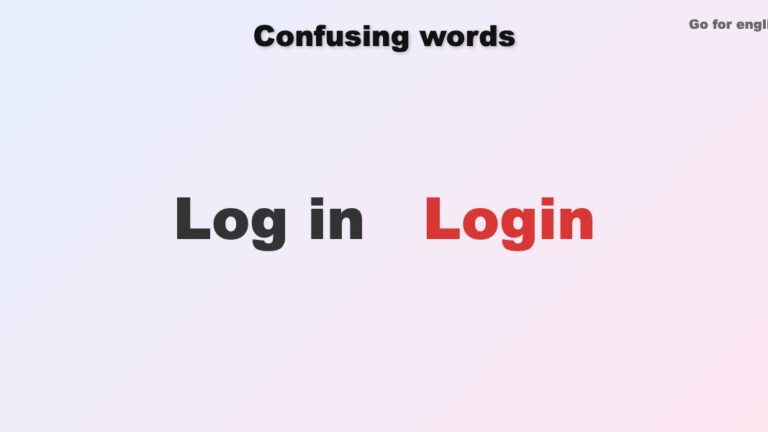
In today’s digital world, where we frequently encounter terms like “log in” and “login,” it’s easy to get tangled up in the nuances of the English language. Many learners find themselves asking: is it “log in” or “login”? This confusion can lead to misunderstandings, especially when communicating in professional or academic contexts. Grasping the distinction between these two terms not only enhances your language skills but also boosts your confidence in digital interactions. In this article, we will unravel the meanings of “log in” and “login,” explore their correct usages, and provide examples to help clarify the difference.
Log in is a verb phrase that refers to the action of accessing a computer system or website by entering credentials, such as a username and password. For example, “I need to log in to my email account.”
Login, on the other hand, is a noun that describes the process of logging in or the credentials used to gain access. For instance, “My login details are saved in my browser.”
In summary, “log in” is the action, while “login” is the noun form describing the act or the credentials. In American English, both forms are widely accepted, while British English tends to use “log in” as a verb and “login” as a noun, aligning with American usage.
What Do ‘Log in vs Login’ Mean?
The terms “log in” and “login” are often used interchangeably in the context of accessing online accounts, but they serve different grammatical roles. “Log in” is a verb phrase that describes the action of entering your credentials to access a digital platform. For example, you might say, “Please log in to your account to view your messages.” On the other hand, “login” is a noun that refers to the credentials or the process itself. You might hear someone say, “I forgot my login information.” Understanding these distinctions is essential for clear communication, especially when discussing online security and access protocols.
‘Log in vs Login’: The Differences
While “log in” and “login” are commonly understood, their usage can vary between regions and styles. In American English, “log in” is frequently used as the action, while “login” might refer to the interface or the information needed to complete that action. In British English, you may encounter a preference for “log in” as well, but you might also find variations that favor “log on” instead. For example, in a British context, one might say, “You need to log on to the website to access your account,” though the term “login” remains universally recognized. This subtlety in language highlights the importance of audience awareness when discussing topics like Log in vs Login, ensuring clarity and accuracy based on regional dialects.
Regional Preferences: Log in vs Login
English is a dynamic language that evolves differently across various regions, leading to interesting variations in usage. One such example is the terms Log in and Login, which may appear to be universally understood but have distinct regional preferences. Choosing the correct form often depends on the audience and the context in which it is used, highlighting the importance of regional nuances in language.
American English
In American English, the term Login is frequently used as a noun to describe the credentials required to access an account. For example: “Please enter your Login to access the system.” In the United States, this version is more commonly used because it succinctly conveys the idea of the credentials in a single word, making it easier for users to understand and remember.
British English
Conversely, British English tends to favor Log in as a verb phrase when referring to the action of accessing an account. For instance: “You need to Log in to your account to view the details.” In British English, this form is preferred, as it adheres to the linguistic rule of using two separate words for actions, thereby enhancing clarity in communication.
Examples in Context: Log in vs Login
Understanding the correct usage of “Log in” and “Login” is crucial for effective communication, especially in digital contexts. Real-life examples help illustrate how each term functions in different scenarios, providing practical insights into their meanings. These examples will equip learners with the confidence to distinguish between “Log in” and “Login” in their writing and conversations.
Log in
Here are some examples demonstrating the proper usage of “Log in”:
- To access your account, you need to log in using your username and password.
- She forgot to log in to the website before trying to download the report.
- Make sure to log in securely to protect your personal information.
- After you log in, you will be redirected to your dashboard.
- The system will prompt you to log in if you haven’t done so already.
- It’s essential to log in every day to keep your progress updated.
- Log in to the platform to participate in the live discussion.
- He always logs in before starting his work to check for any updates.
Login
Here are some examples demonstrating the proper usage of “Login”:
- The login page of the application is user-friendly and easy to navigate.
- After entering your login details, click the button to proceed.
- She received an email to verify her login credentials.
- Ensure your login information is stored securely to prevent unauthorized access.
- The website’s login process requires two-factor authentication for added security.
- He had trouble with his login, so he reset his password.
- The application crashed during the login attempt, causing frustration.
- For security reasons, the login system will lock your account after three failed attempts.
Synonyms & Antonyms of Log in vs Login
Understanding synonyms and antonyms is crucial for enhancing your vocabulary and mastering the English language. Synonyms enrich our speech and writing by offering alternative words that convey similar meanings, making our communication more engaging. Conversely, antonyms help clarify the exact meaning of a word by presenting its opposite, allowing for better comprehension. By familiarizing yourself with different word choices, you can express yourself more fluently and naturally in English.
| Term | Synonyms | Antonyms |
|---|---|---|
| Log in | Sign in, Access, Enter | Log out, Sign out, Disconnect |
| Login | Access credentials, User credentials, Sign-in information | Logout, Sign-out |
Common Mistakes and How to Avoid Them
Understanding the common mistakes between “Log in” and “Login” is crucial for mastering English, even for advanced learners. These errors can affect your writing clarity and overall fluency. By learning to identify and correct these mistakes, you can enhance your communication skills significantly.
- Mistake: Using “login” as a verb.
Correction: Use “log in” when describing the action of entering a system. For example, say “I need to log in to my account.” Remember, “login” is a noun. - Mistake: Writing “log in” as one word.
Correction: Always use “log in” as two separate words when used as a verb. For instance, “You should log in to access your profile.” - Mistake: Confusing “login” with “log in” in technical contexts.
Correction: Use “login” when referring to the credentials or interface, such as “Enter your login details.” Reserve “log in” for the action. - Mistake: Inconsistent usage between British and American English.
Correction: Both American and British English use “log in” and “login” in the same way, but be attentive to regional preferences in other contexts for clarity. - Mistake: Misusing “log in” in formal writing.
Correction: In formal contexts, ensure you differentiate between verb and noun usage. For example, “Please provide your login information before you log in.”
Tips for Correct Usage
Mastering the correct usage of “Log in” vs “Login” is essential for clear and professional writing. Using these terms accurately not only enhances the readability of your content but also reflects your attention to detail and grammatical accuracy. Below are practical tips to help you differentiate between “Log in” and “Login” effectively.
- Understand the difference: “Log in” is a verb phrase, while “Login” is a noun. Use them according to their grammatical roles.
- Use “Log in” for actions: When referring to the act of accessing a system, always choose “Log in.” This clarifies the action being performed.
- Choose “Login” for noun usage: When you refer to the credentials or the interface (like a login page), use “Login.” This helps maintain clarity in your writing.
- Be consistent: Stick to one form throughout your writing. If you start with “Log in,” continue using it as a verb and use “Login” solely as a noun.
- Consider regional differences: Be aware that some regions may have different preferences for these terms. Research your audience to ensure appropriate usage.
- Avoid common mistakes: Do not confuse the two forms; remember that “Log in” requires a space and is action-oriented, while “Login” is a single word representing a concept.
- Proofread your work: Always review your content to ensure you have used “Log in” and “Login” correctly, enhancing the professionalism of your writing.
Frequently Asked Questions
What is the difference between ‘log in’ and ‘login’?
‘Log in’ is a verb phrase referring to the action of accessing an account, while ‘login’ is a noun that denotes the credentials or the process itself.
Can I use ‘log in’ as a noun?
No, ‘log in’ is not used as a noun. Use ‘login’ for the noun form when referring to the credentials or the action of logging in.
Is ‘log in’ always two words?
Yes, ‘log in’ is always written as two separate words when used as a verb phrase.
When should I use ‘login’?
Use ‘login’ when you are referring to the information needed to access an account, such as a username and password.
Are ‘log in’ and ‘login’ interchangeable?
No, they serve different grammatical purposes; ‘log in’ is an action, while ‘login’ describes the noun concept.
How do you use ‘log in’ in a sentence?
You would say, “Please log in to your account to view your messages.” This shows the action of accessing an account.
What is the correct form for a button that allows access?
The button should be labeled as “Log In” to indicate the action users need to take to access their accounts.
What is an example of ‘login’ in a sentence?
An example would be, “Enter your login details to access the system,” which uses ‘login’ as a noun.