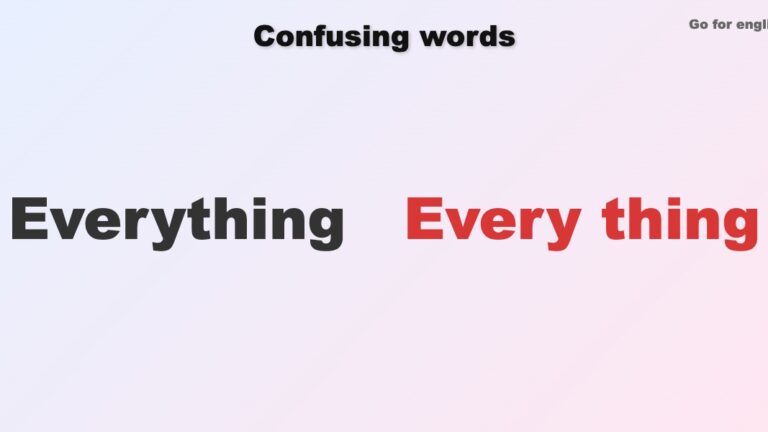
In the vast world of the English language, even the simplest terms can spark confusion, and the distinction between “everything” and “every thing” is no exception. For learners, grasping the nuances between these two phrases isn’t just an exercise in vocabulary; it’s essential for clear communication and writing precision. Misusing them can lead to misunderstandings or a perceived lack of fluency. By delving into the intricacies of these expressions, we can demystify their differences and help you enhance your English skills. Let’s explore the definitions, uses, and examples of “everything” and “every thing” to clarify this common dilemma.
Everything is a single word that refers to all things or the entirety of a particular situation or context. It is commonly used in both American and British English without any variation in meaning. For example, “Everything is ready for the party.” This term emphasizes completeness or totality.
On the other hand, Every thing is a two-word phrase that is less commonly used and typically refers to individual items or objects, often in a more specific context. It is generally used when one wants to emphasize the distinct nature of each item. For example, “Every thing on the list needs to be checked.” This usage is more formal and can sound awkward in casual conversation.
In summary, “everything” is the preferred and more commonly used form in modern English, while “every thing” is rarely used and may come off as outdated or overly formal.
What Do ‘Everything vs Every thing’ Mean?
The terms ‘everything’ and ‘every thing’ often confuse English learners due to their similar appearance and pronunciation. However, they serve different grammatical roles and meanings. ‘Everything’ is a single word that functions as a pronoun, used to refer to all things collectively or as a whole. For example, in the sentence, “She brought everything we needed for the picnic,” ‘everything’ encompasses all the items necessary for the event.
On the other hand, ‘every thing’ is less common and is used when emphasizing individual items or components within a group. It breaks down the concept into discrete units, often seen in more formal or literary contexts. For instance, “Every thing in this room has a story to tell,” highlights the individuality of each item rather than collectively referencing them.
‘Everything vs Every thing’: The Differences
The distinction between ‘everything’ and ‘every thing’ can lead to different interpretations and stylistic choices in writing. In American English, ‘everything’ is predominantly used in both casual and formal contexts, while ‘every thing’ might appear in literature or poetry, where an emphasis on individual elements is desired.
In British English, there is a similar trend, with ‘everything’ being the preferred option. However, you might occasionally find ‘every thing’ employed for emphasis or clarity. For example, “In this garden, every thing blooms beautifully in spring,” emphasizes the individual beauty of each plant. Overall, while ‘everything’ is widely accepted and understood in everyday language, ‘every thing’ serves as a stylistic choice that can enrich the meaning in specific contexts.
Regional Preferences: Everything vs Every thing
The English language showcases a rich tapestry of regional variations that can sometimes lead to confusion for learners. One interesting distinction is the usage of Everything vs Every thing, which may appear straightforward but carries different implications depending on the context. Understanding these regional preferences is essential for effective communication, as the choice between these forms can affect clarity and relatability with the audience.
American English
In American English, the preferred usage is Everything. For example, “I want to know everything about the project.” This version is more commonly used because it conveys a sense of totality and completeness in a more fluid, single-word format, which aligns with the linguistic tendencies in American speech.
British English
In British English, the form Every thing is often more accepted in contexts where emphasis on individual items is necessary, such as in the sentence, “I want to consider every thing before making a decision.” In British English, this form is preferred as it aligns with the structure that emphasizes the distinctness of each item, allowing for clarity in more formal or detailed discussions.
Examples in Context: Everything vs Every thing
Understanding the correct usage of “Everything” and “Every thing” is crucial for clear communication in English. Real-life examples can provide practical insights into how each term is used in different contexts. These examples will help learners confidently distinguish between “Everything” and “Every thing” in their writing and conversations.
Everything
1. Everything you need for the project is included in the kit.
2. She believes that everything happens for a reason.
3. Everything he said during the meeting was insightful.
4. I can’t believe everything is on sale this weekend!
5. Everything will be ready by the time you arrive.
6. They promised that everything would be taken care of.
7. Everything in this store is made from organic materials.
8. Make sure you bring everything you need for the trip.
Every thing
1. Every thing on the list must be completed before the deadline.
2. She checked every thing in the box to ensure nothing was missing.
3. I appreciate every thing you have done for me.
4. Every thing you need to know about the vacation is in this brochure.
5. He organized every thing neatly on his desk.
6. She wants to examine every thing closely before making a decision.
7. Every thing has its place in this system.
8. I will consider every thing before I respond to the offer.
Synonyms & Antonyms of Everything vs Every thing
Learning synonyms and antonyms is crucial for enhancing your vocabulary and communication skills. Synonyms allow you to add variety to your speech and writing, making your language more engaging and expressive. On the other hand, antonyms provide clarity by highlighting the opposite meanings of words, ensuring that you convey your thoughts accurately. By expanding your knowledge of different word choices, you’ll sound more fluent and natural in English, which is essential for effective communication.
| Term | Synonyms | Antonyms |
|---|---|---|
| Everything | All, All things, The whole lot | Nothing, Null, Zero |
| Every thing | Each thing, Every single item | No things, No items |
Common Mistakes and How to Avoid Them
Understanding common mistakes is essential for mastering the distinction between “everything” and “every thing.” Even advanced learners can stumble upon these errors, and learning to correct them will significantly enhance your fluency and accuracy in English. In this guide, we’ll cover the most frequent mistakes and provide actionable recommendations to help you avoid them.
- Mistake: Using “everything” when referring to individual items.
- Correction: Use “every thing” when you are talking about separate, countable items. For example, instead of saying “I need to pack everything for the trip,” say “I need to pack every thing I might need, such as clothes, toiletries, and documents.”
- Mistake: Confusing “everything” as a synonym for “all things.”
- Correction: Remember that “everything” refers to a single concept or totality, while “every thing” focuses on individual components. Use “everything” when speaking about a collective idea, e.g., “Everything is ready for the meeting.”
- Mistake: Misplacing “everything” in a sentence.
- Correction: Ensure “everything” is used in the correct context. Instead of saying “I brought everything my laptop and charger,” say “I brought everything: my laptop and charger.”
- Mistake: Not recognizing regional differences in usage.
- Correction: Be aware that in some dialects, “every thing” might be used more frequently in technical contexts, such as in academic writing. Familiarize yourself with the conventions of the specific English variant you are learning.
- Mistake: Using “everything” in formal writing where “every thing” might be more appropriate.
- Correction: In formal contexts, clarify when referring to discrete items. For instance, “Each every thing in this report was carefully analyzed” could be better phrased as “Every thing in this report was carefully analyzed.”
Tips for Correct Usage
Mastering the correct usage of “everything” vs. “every thing” is crucial for effective communication in writing. Using these terms correctly enhances clarity, professionalism, and grammatical accuracy, ensuring your message is easily understood. Below are practical tips to help you navigate the nuances between these two terms.
- Understand the Definition: Remember that “everything” is a single word used to refer to all things collectively, while “every thing” is rarely used and typically refers to individual items in a specific context.
- Context Matters: Use “everything” in most situations when discussing generalities or totalities. Reserve “every thing” for instances where you want to emphasize distinct items.
- Check for Redundancy: Avoid using “every thing” unless necessary; it can often make your writing unnecessarily complicated.
- Maintain Consistency: Choose one form based on your context and stick to it throughout your writing to avoid confusion.
- Consider Regional Variations: Be aware that some English dialects may have specific preferences for usage; familiarize yourself with these if your audience is regional.
- Proofread for Clarity: After writing, review your work to ensure you’ve used “everything” or “every thing” correctly, enhancing the clarity of your message.
- Use Tools Wisely: Leverage grammar-checking tools to help identify potential errors, but remember they may not always distinguish between the two forms.
Frequently Asked Questions
What is the difference between “everything” and “every thing”?
“Everything” is a single word that refers to all things collectively, while “every thing” is a less common phrase that can refer to individual items in a group.
Is “every thing” grammatically correct?
Yes, “every thing” is grammatically correct but is rarely used; “everything” is preferred in most contexts.
When should I use “everything”?
You should use “everything” when referring to all items, concepts, or people in a general sense.
Can “every thing” be used in formal writing?
While “every thing” can be used in formal writing, it is advisable to use “everything” for clarity and to adhere to standard usage.
Are there any specific contexts for using “every thing”?
“Every thing” might be used in specific contexts where you want to emphasize individual items, but it’s quite rare.
How do I remember the difference between “everything” and “every thing”?
Remember that “everything” is a single, all-encompassing term, while “every thing” highlights individual items; focusing on context can help you choose the right form.
Is “everything” a noun or an adjective?
“Everything” is a pronoun that acts as a noun, representing all things collectively.
Can “every thing” be found in dictionaries?
Yes, “every thing” can be found in some dictionaries, but it is often labeled as an alternative form of “everything.”