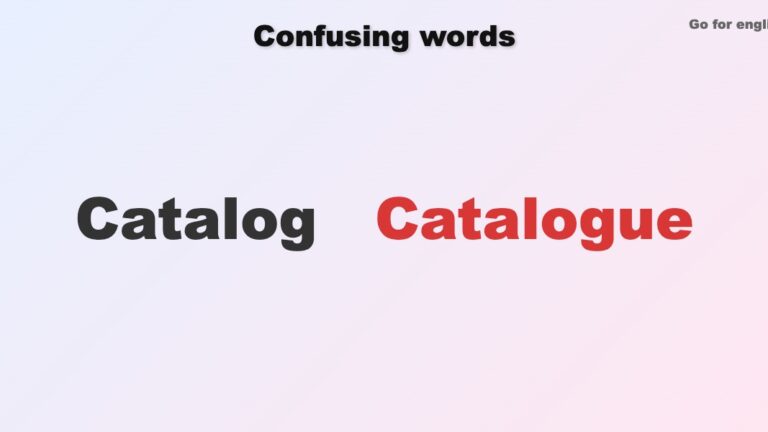
In the world of English, even the simplest words can spark confusion, and the terms “catalog” and “catalogue” are prime examples. For learners and enthusiasts alike, grasping the distinction between these two variations is crucial, not only for mastering vocabulary but also for enhancing writing precision. Understanding whether to use the American spelling “catalog” or the British “catalogue” can affect clarity in communication and demonstrate a command of language nuances. In this article, we will delve into the origins, uses, and contexts of both terms, helping you navigate this common linguistic dilemma with confidence.
Catalog vs Catalogue: The terms “catalog” and “catalogue” refer to a systematic list of items, often used in contexts such as libraries, retail, and databases. The main difference lies in regional spelling preferences. “Catalog” is the preferred spelling in American English, while “catalogue” is commonly used in British English. Both terms serve the same purpose, but their usage can indicate the writer’s regional background. In summary, use “catalog” for American audiences and “catalogue” for British ones.
What Do ‘Catalog vs Catalogue’ Mean?
The terms ‘catalog’ and ‘catalogue’ refer to a systematic list or record of items, often used in contexts such as libraries, stores, or databases. Both words serve as nouns and can describe collections of books, products, or documents. The primary difference lies in spelling and regional usage. In American English, ‘catalog’ is the preferred spelling, while in British English, ‘catalogue’ is commonly used.
For example, you might say, “The library’s catalog makes it easy to find books.” In this sentence, ‘catalog’ indicates a structured list of available books, showcasing its role as a noun in a practical context.
‘Catalog vs Catalogue’: The Differences
The distinction between ‘catalog’ and ‘catalogue’ extends beyond mere spelling; it reflects regional preferences and stylistic choices. In American English, ‘catalog’ is predominantly used, while British English favors ‘catalogue.’ This difference is evident in various publications and everyday language. For instance, an American retailer might advertise, “Check out our new spring catalog,” whereas a British shop might say, “Browse our latest spring catalogue.”
Furthermore, although the meanings remain consistent, the choice of spelling can influence the tone and audience perception. Using ‘catalogue’ in a British context might convey a more traditional or formal approach, while ‘catalog’ may seem more modern and straightforward. Understanding these nuances can enhance your communication effectiveness, especially in international settings.
Regional Preferences Catalog vs Catalogue
English is a dynamic language that varies significantly across different regions, reflecting diverse cultural influences and linguistic evolution. One area of variation is the preference for spelling, particularly with words like Catalog vs Catalogue. While both forms are understood globally, their usage depends heavily on the audience and context. Understanding these regional differences can enhance clarity and communication.
American English
An example sentence demonstrating its use in American English is: “The library has an extensive Catalog of available resources.” In the United States, this version is more commonly used because American English tends to adopt simpler spellings and often favors shorter forms of words. This preference aligns with the overall trend of American English towards efficiency and accessibility in language.
British English
An example sentence demonstrating its use in British English is: “The university published a new Catalogue of courses for the upcoming semester.” In British English, this form is preferred, as it follows traditional spelling conventions that often retain the ‘ue’ in words. This reflects a connection to the historical roots of the language and a tendency to maintain more formal spelling standards.
Examples in Context: Catalog vs Catalogue
Understanding the correct usage of “Catalog” and “Catalogue” is essential for English learners, as the two terms can often cause confusion. Real-life examples provide practical insights into how each term is used in different contexts, allowing learners to grasp their meanings and applications more effectively. By examining these examples, learners will gain the confidence needed to distinguish between “Catalog” and “Catalogue” in their writing and conversations.
Examples of “Catalog”
- The library has created a digital catalog of all its available resources.
- In the retail industry, a product catalog is essential for showcasing items to customers.
- She was excited to receive the new catalog from her favorite online store.
- The university’s course catalog includes detailed descriptions of each subject.
- During the meeting, he presented a catalog of the company’s past achievements.
- The catalog for the upcoming art exhibit features works by local artists.
- They decided to compile a catalog of their vinyl record collection.
- The software allows users to easily create and manage their product catalog.
Examples of “Catalogue”
- The museum’s catalogue of exhibits is available online for visitors.
- She spent the afternoon updating the catalogue of her extensive book collection.
- His research paper included a comprehensive catalogue of historical documents.
- The annual catalogue from the fashion house displays the latest trends.
- We received the new catalogue for the upcoming gardening season in the mail.
- The university issued a catalogue of all available scholarships for students.
- To better understand the subject, she referred to the catalogue of previous conference papers.
- The catalogue of films available for streaming is constantly updated.
Synonyms & Antonyms of Catalog vs Catalogue
Learning synonyms and antonyms is crucial for enhancing vocabulary and overall language proficiency. Synonyms offer a variety of word choices in both speech and writing, making communication more engaging. On the other hand, antonyms help clarify the meaning of a word by providing its opposite, thereby aiding in better understanding. By expanding their knowledge of different words, learners can express themselves more fluently and naturally in English.
| Word | Synonyms | Antonyms |
|---|---|---|
| Catalog | List, Inventory, Register, Directory | Disorder, Chaos, Confusion |
| Catalogue | List, Record, Index, Compilation | Disorganization, Disarray, Scatter |
Common Mistakes and How to Avoid Them
Understanding common mistakes in English, particularly with words like “Catalog” vs “Catalogue,” is essential for mastering the language. Even advanced learners can stumble over these differences, and correcting them enhances both fluency and accuracy in writing and speaking.
- Using “Catalog” and “Catalogue” interchangeably: Remember that “Catalog” is the American English spelling, while “Catalogue” is the British English version. To avoid confusion, choose one spelling based on your audience and stick with it throughout your text.
- Incorrect usage in formal vs informal contexts: “Catalog” is often preferred in business and technical writing, while “Catalogue” can be used in literary or academic contexts. Be aware of your context to select the appropriate term.
- Misunderstanding the meaning: Some learners confuse “catalog” with “inventory.” A catalog is a complete list or collection, while inventory refers to stock on hand. To avoid this mistake, ensure you understand the specific meanings and contexts of each term.
- Neglecting regional variations: If you’re writing for an international audience, consider using “Catalog” for an American audience and “Catalogue” for British readers. When in doubt, research your target demographic to tailor your language accordingly.
- Forgetting the correct plural form: The plural form of “catalog” is “catalogs,” while the plural of “catalogue” is “catalogues.” Pay attention to these details to maintain grammatical accuracy in your writing.
Tips for Correct Usage
Mastering the correct usage of “Catalog” vs “Catalogue” is essential for clear and professional writing. Understanding the nuances between these terms not only enhances your grammatical accuracy but also helps convey your message effectively to your audience. Below are practical writing tips to ensure you use these terms correctly.
- Know the Regional Differences: Use “Catalog” in American English and “Catalogue” in British English. Choose based on your target audience’s location.
- Consider Context: Use “Catalog” for digital or modern contexts, and “Catalogue” for traditional or formal settings.
- Be Consistent: Stick to one spelling throughout your document to maintain a professional tone and avoid confusion.
- Check Your Style Guide: Refer to any relevant style guides (like APA or MLA) that may dictate the preferred spelling based on your field of study or profession.
- Avoid Confusion: Don’t use both spellings interchangeably within the same document to prevent ambiguity.
- Proofread for Clarity: Always double-check your work to ensure you’re using the correct term based on your audience and context.
Frequently Asked Questions
What is the difference between catalog and catalogue?
The difference lies in spelling; “catalog” is the American English version, while “catalogue” is the British English variant. Both terms refer to a list or collection of items.
Is “catalog” or “catalogue” more commonly used?
Can I use “catalog” in British English?
Yes, “catalog” can be used in British English, especially in informal contexts or in American-influenced media, but “catalogue” is the traditional spelling.
Are there any differences in meaning between catalog and catalogue?
No, there is no difference in meaning; both terms refer to the same concept of a systematic list or collection.
Which spelling should I use for formal writing?
Use “catalogue” for formal writing in British English and “catalog” for formal writing in American English to align with regional standards.
How do I know which spelling to use?
Consider your audience and the regional variation of English they use; if writing for an American audience, use “catalog,” and for a British audience, use “catalogue.”
Is there a plural form for catalog and catalogue?
Yes, the plural form is “catalogs” for American English and “catalogues” for British English.
Can I find both spellings in dictionaries?
Yes, most reputable dictionaries include both “catalog” and “catalogue,” often noting the regional differences in usage.