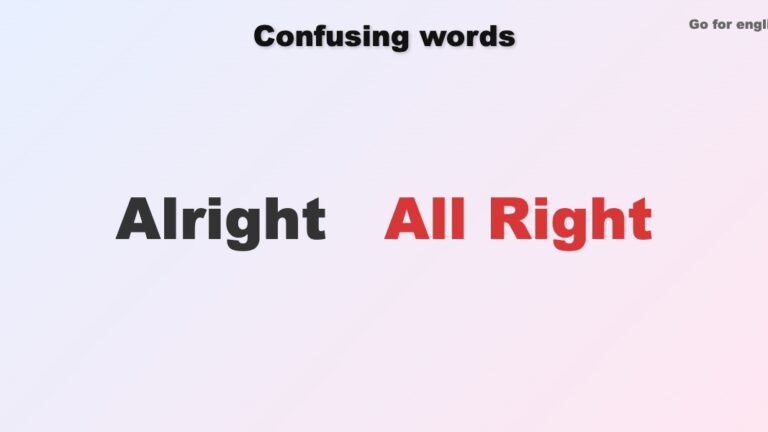
In the world of written English, few pairs of words stir as much debate as “alright” and “all right.” For many learners, distinguishing between these two forms can feel like navigating a linguistic minefield. Understanding the subtle differences between them is essential, not only for mastering the nuances of the language but also for communicating effectively in both casual and formal contexts. Join us as we delve into the meanings, usages, and grammatical guidelines that will clarify when to use “alright” versus “all right,” ensuring you can express yourself with confidence and precision.
Alright vs All Right: A Quick Summary
Both “alright” and “all right” are used to indicate that something is acceptable or satisfactory. However, “all right” is the traditional and grammatically correct form, while “alright” is considered more informal and is often viewed as a nonstandard variant.
Usage: “All right” is preferred in formal writing and is widely accepted in both American and British English. “Alright,” on the other hand, is increasingly used in informal contexts, especially in conversational English and online communications.
Key Differences: The primary difference lies in their formality and acceptance. While “all right” is universally recognized, some language purists argue that “alright” should be avoided in formal writing. Furthermore, “all right” can also mean “not wrong,” while “alright” is often used in more casual expressions.
In summary, while both forms convey a similar meaning, “all right” is the recommended choice for clarity and correctness, especially in academic or professional settings.
What Do ‘Alright vs All Right’ Mean?
The terms “alright” and “all right” are often used interchangeably, but they have distinct nuances in meaning and usage. “All right” is the traditional form and is widely accepted in both formal and informal contexts. It is an adjective that means “satisfactory” or “acceptable.” For example, you might say, “The movie was all right, but I expected more excitement.” On the other hand, “alright” is a more informal variant that has gained popularity, particularly in colloquial speech and writing. While some critics argue that “alright” is less formal and should be avoided in serious writing, it is commonly used in everyday language. An example sentence using “alright” could be, “It’s alright to take a break if you’re feeling tired.” Understanding these terms helps clarify their roles in English communication.
‘Alright vs All Right’: The Differences
The distinction between “alright” and “all right” extends beyond their meanings; it also encompasses regional preferences and stylistic choices. In American English, “alright” is frequently seen in informal contexts, such as in dialogues or creative writing, while “all right” remains the preferred form in formal writing. British English tends to favor “all right” as well, although “alright” is gaining traction among younger speakers. For instance, a British author might write, “Everything is all right,” to convey a sense of reassurance, while an American character in a novel might say, “It’s alright, don’t worry!” This variation highlights how “alright vs all right” can reflect not only language evolution but also cultural differences in expression. Understanding these distinctions can enhance your grasp of English nuances, making your communication more effective and contextually appropriate.
Regional Preferences: Alright vs All Right
English is a diverse language with variations that reflect the cultural and linguistic nuances of different regions. While the terms Alright and All Right may seem universally understood, their usage can differ significantly based on location. Choosing the correct form often depends on the audience and context, making it essential to understand these regional preferences.
American English
In American English, the term Alright is often used informally. For example, “I’m feeling Alright after that long meeting.” This version is more commonly accepted in casual conversations and informal writing, as it conveys a relaxed tone that resonates with American culture.
British English
Conversely, in British English, the preferred form is All Right. For instance, “Everything is All Right with the plans for tomorrow.” This form is favored as it adheres to traditional grammatical standards, reflecting a more formal approach to language in Britain.
Examples in Context: Alright vs All Right
Understanding the correct usage of “alright” and “all right” can be challenging for learners of English. Real-life examples play a crucial role in clarifying the differences between these terms, providing practical insights into how each is used in various contexts. By examining these examples, learners can confidently distinguish between “alright” and “all right” in their writing and conversations.
Examples of Alright
- It was an alright movie, but I expected more from the director.
- After a long day, I felt alright about skipping the gym.
- She assured me that everything would be alright in the end.
- His explanation was alright, but it could have been clearer.
- Despite the rain, we had an alright time at the picnic.
- It’s not the best idea, but it’s alright if you want to try it.
- He was feeling alright after taking some medicine.
- Her performance was alright, but she can do better.
Examples of All Right
- Are you all right after the fall?
- It’s all right to ask for help when you need it.
- We’ll meet at the café at 3 PM; is that all right with you?
- Everything will be all right if we work together.
- He assured his parents that he was all right living on his own.
- It’s all right to make mistakes as long as you learn from them.
- She passed all her exams, and that made her feel all right.
- Is it all right if I borrow your book for a week?
Synonyms & Antonyms of Alright vs All Right
Expanding your vocabulary is essential for effective communication in English. Learning synonyms allows you to add variety to your speech and writing, making your language more engaging. On the other hand, understanding antonyms helps clarify the precise meaning of a word, ensuring that you convey your thoughts accurately. By familiarizing yourself with different word choices, you’ll sound more fluent and natural in English. Below is a table listing the synonyms and antonyms for “alright” and “all right.”
| Word | Synonyms | Antonyms |
|---|---|---|
| Alright | Okay, Fine, Acceptable, Satisfactory | Unacceptable, Unsatisfactory, Poor |
| All Right | All good, Correct, Right, Just fine | Wrong, Incorrect, Bad |
Common Mistakes and How to Avoid Them
Understanding the common mistakes between “alright” and “all right” is essential for mastering English. Even advanced learners can stumble upon these terms, leading to confusion in both writing and conversation. Correcting these errors not only enhances fluency but also improves overall accuracy in communication.
- Using “alright” in formal writing: Many people mistakenly use “alright” in academic or professional contexts. Correction: Opt for “all right” in formal writing to maintain professionalism.
- Assuming “alright” is universally accepted: Some learners believe “alright” is always correct due to its common usage in informal settings. Correction: Remember that “alright” is often considered nonstandard; use “all right” for clarity.
- Mixing up meanings: Learners sometimes confuse the meanings of “alright” and “all right.” Correction: Use “all right” to indicate approval or correctness, while “alright” can imply a more casual acceptance.
- Regional differences in usage: “Alright” is more accepted in British English but still debated. Correction: Be aware of your audience; use “all right” in contexts where formality is necessary, regardless of region.
- Overusing “alright” in speech: While “alright” may slip into casual conversation, it can sound informal. Correction: Practice switching to “all right” to adapt speech for different contexts.
Tips for Correct Usage
Mastering the correct usage of “Alright” vs “All Right” is essential for clear and professional writing. Knowing when to use each term can enhance your communication by ensuring grammatical accuracy and clarity. Here are some practical writing tips to help you navigate these terms effectively.
- Use “All Right” in formal writing: Reserve “All Right” for academic papers, business communications, and other formal contexts.
- Consider “Alright” as informal: Utilize “Alright” in casual conversations or creative writing, where a relaxed tone is appropriate.
- Be aware of regional preferences: Recognize that “Alright” is more commonly accepted in British English, while “All Right” is preferred in American English.
- Avoid using “Alright” in professional documents: To maintain professionalism, stick to “All Right” in resumes, cover letters, and official reports.
- Remember that “All Right” is grammatically correct: “All Right” is the standard form and should be used when in doubt.
- Pay attention to context: Choose based on the tone and audience of your writing. If unsure, opt for “All Right” for clarity.
- Check for consistency: If you choose to use “Alright,” ensure it is consistently used throughout your text to avoid confusion.
Frequently Asked Questions
What is the difference between “alright” and “all right”?
“Alright” is an informal variant of “all right,” which is considered more standard in formal writing. While both can be used to mean satisfactory or okay, “all right” is preferred in academic and professional contexts.
Is “alright” a real word?
Yes, “alright” is recognized as a word in informal English, but many style guides recommend using “all right” in formal writing.
Can I use “alright” in formal writing?
It is advisable to avoid “alright” in formal writing, as “all right” is the grammatically correct form preferred by most editors and style guides.
When should I use “all right”?
You should use “all right” when you want to convey that something is correct, satisfactory, or acceptable, particularly in written communication.
Is “alright” considered grammatically incorrect?
While “alright” is widely used and understood, it is often viewed as less formal and may be considered incorrect in strict grammatical terms.
Are there specific contexts for using “alright”?
“Alright” is commonly used in casual conversations, social media, and informal writing, but should be avoided in professional or academic settings.
Can “all right” be used in a positive context?
Yes, “all right” can indicate approval or acceptance, and is often used to express that something is satisfactory or meets expectations.
How do I remember when to use “alright” vs “all right”?
A helpful tip is to remember that “all right” is the standard form, while “alright” is more casual; opt for “all right” in any situation where formal language is expected.